Quick Answer:
Backlighting onyx or translucent stone evenly depends on the gap between the light source and the slab, not on raw brightness. An area source at 324 LEDs per square foot has far less to blend than spaced point sources, so it reads as an even glow at the shallow clearances a countertop allows. Use the screw spacer set to hold the gap consistent, and test the specific slab on a mockup — density and veining change the diffusion distance required.
Backlit onyx is one of the least forgiving applications in architectural lighting. The stone itself is the diffuser, and it is a poor one — translucency varies across a single slab, veining changes thickness unpredictably, and the material was formed by geology rather than specified to a tolerance. Any unevenness in the light behind it is amplified rather than hidden.
The result is that a lighting approach which performs acceptably behind acrylic can look obviously wrong behind stone. Getting it right requires an even source, a controlled gap, and a realistic understanding of what the slab will and will not conceal.
Why is backlighting stone harder than backlighting acrylic?
The material varies
Acrylic and resin panels diffuse consistently because they are manufactured to do so. Onyx, alabaster, and translucent marble do not. Thickness varies, mineral density varies, and veining runs through the slab in ways that transmit light very differently from the surrounding material. A source that is even will still produce a varied surface — but that variation reads as the stone’s character. A source that is uneven adds a second pattern on top, and the two together read as a defect.
Low diffusion
Stone slabs are typically cut thin for backlighting — often 20mm or less, sometimes laminated to glass for strength. Thin stone scatters light less than a purpose-made diffuser, so the source geometry shows through more readily. Anything resembling a line or a dot pattern behind the slab will be visible on the face.
Shallow build-ups
A backlit countertop, bar front, or reception desk is usually built into millwork with a fixed thickness. The cavity behind the stone is whatever the joinery detail permits, and it is rarely generous. That constrains the blending distance available.
“Backlit stone has become a signature design element in luxury hospitality. The key is uniform lighting with zero hotspots—LightWave’s density gets us there.”
— aweyer, Lighting Applications Engineer, LUXX
Why is a flexible LED sheet the right source for stone?
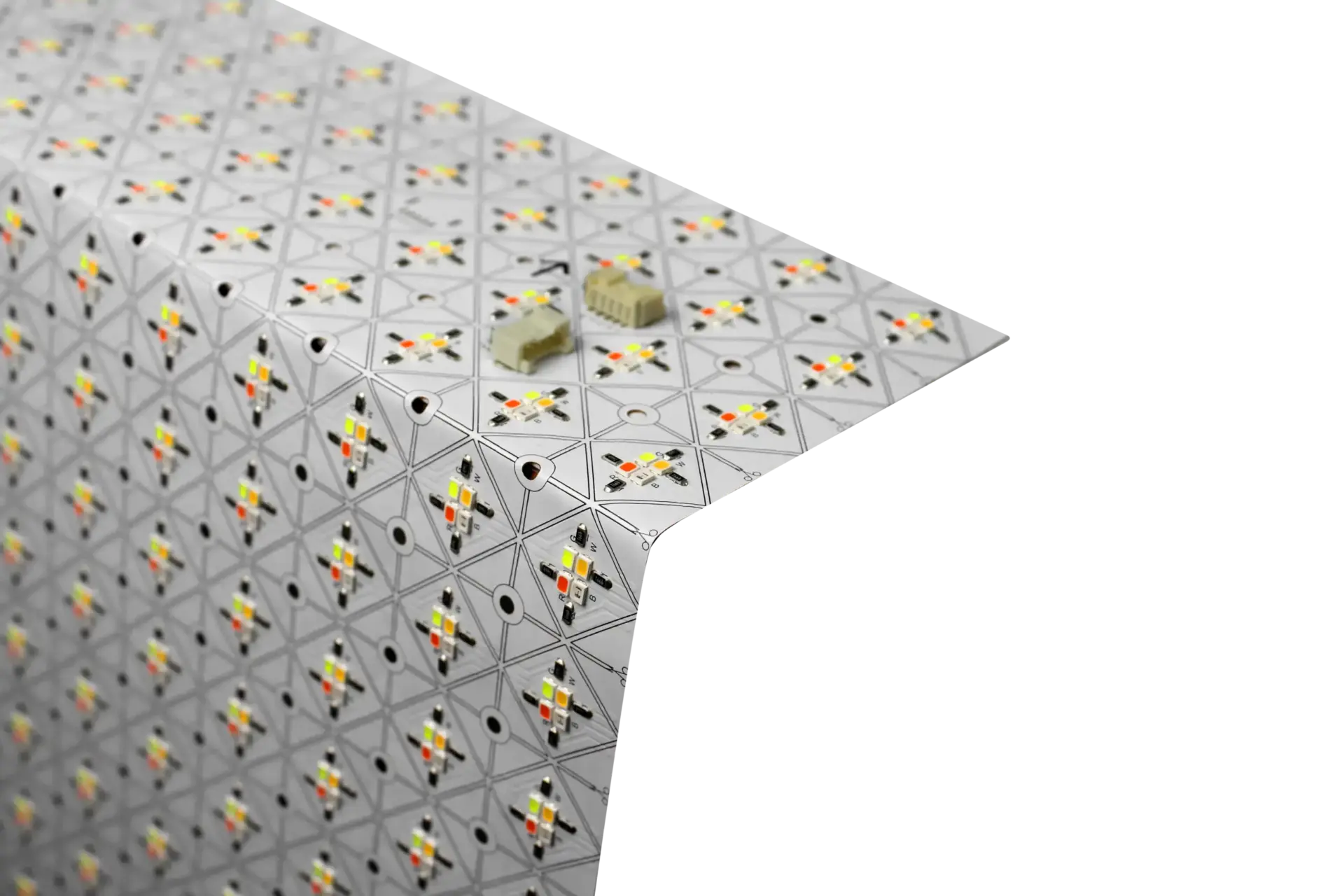
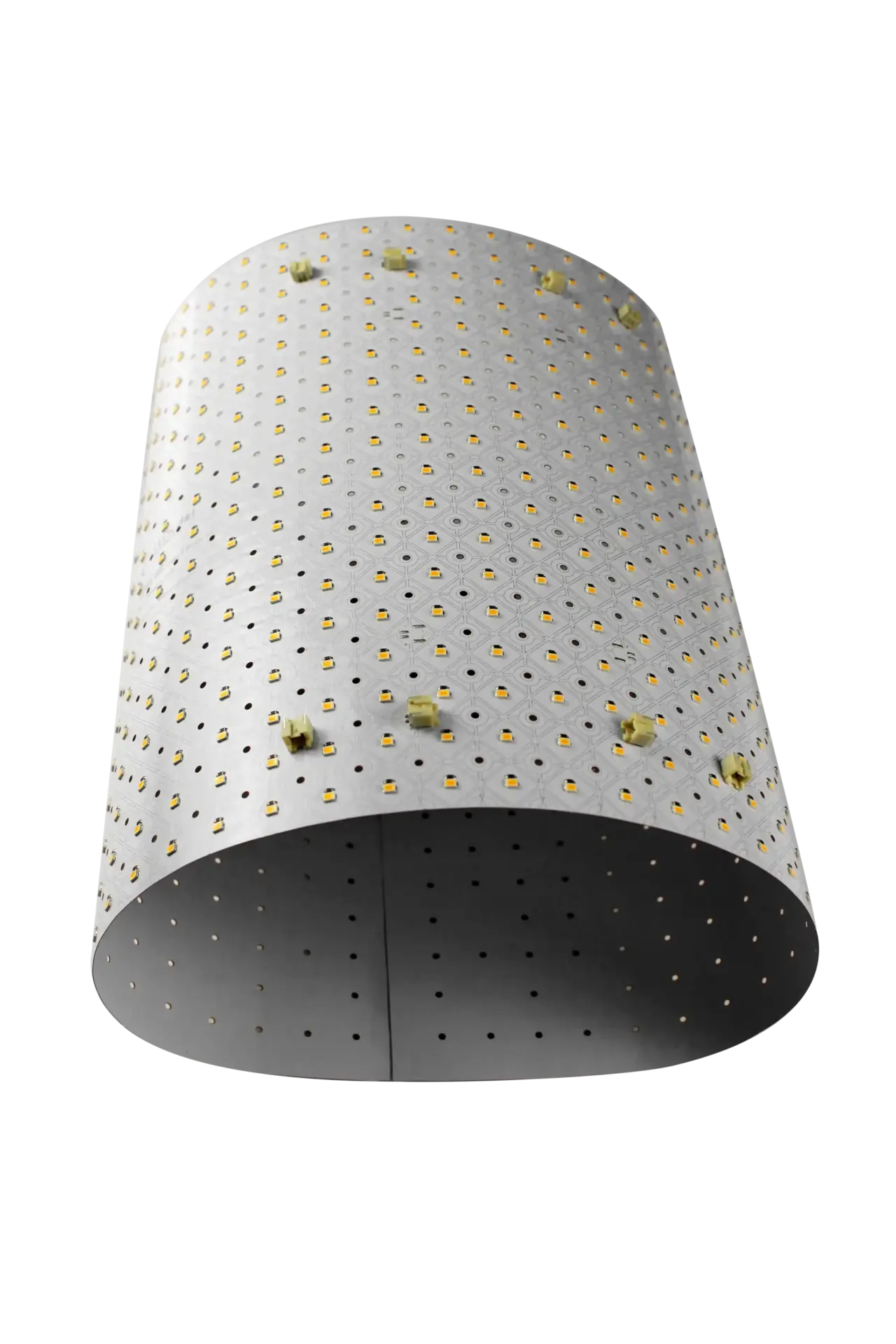
LightWave Generation 1 Plus sheets are under 7mm thick with 648 diodes in a 12 by 24 inch module. High density means very little blending distance is needed; the thin profile means the joinery detail does not have to grow to accommodate the lighting.
This is the same thin-profile technology across LUXX’s flexible LED light sheets range, sized here for shallow joinery details.
Building up an irregular area
Countertops and bar fronts are rarely simple rectangles. Sink cut-outs, returns, waterfall edges, and mitred corners all interrupt the lit area. Generation 1 Plus is modular and cuts along designated lines, so the lit field is assembled to follow the stone rather than forcing the stone to accommodate a fixed module. Cut only on designated lines — cutting elsewhere severs circuit paths.
Setting the gap
The screw spacer set holds the sheets at a consistent offset behind the stone. On this application consistency of the gap matters as much as its size: a sheet that sits 6mm behind the slab in one area and flush in another will produce visibly different brightness in each, and the stone will not hide it. A component-set offset removes that variable from installer judgment.
Heat and the millwork
Stone is often bonded to a substrate and set into joinery with adhesives and sealants that have temperature limits. Thermal clearance behind the sheet protects those materials as well as the LEDs. Sealing sheets into an airtight cavity behind a stone slab is a common detail and a poor one.
The same thermal-clearance principle governs enclosed architectural cove lighting details.
How do you specify backlit stone?
Color temperature
Warm temperatures flatter the amber, honey, and cream tones typical of onyx and alabaster. 2700K to 3000K is the usual choice for hospitality and residential work, with 3500K where the surrounding scheme is more neutral. Both 2700K and 3000K are by-request temperatures on Generation 1 Plus rather than standard stock, so confirm lead time before the joinery programme is fixed.
Cooler temperatures push honey-toned stone towards grey and generally read as a mistake. Where the stone is a cool white marble rather than onyx, that changes — sample the actual slab under the actual proposed temperature before committing.
Test the actual slab
This is the single most valuable step in a stone backlighting package and the one most often skipped. Slabs differ. Mock up the real material against the proposed source and gap before the joinery is fabricated. What the sample tells you about brightness, color, and how the veining transmits is worth more than any calculation.
Power and dimming
Generation 1 Plus draws 14W per 12 by 24 inch sheet in single color, producing 1,580 to 1,720 lumens at 113 to 123 lm/W, Ra 80+. Tunable white runs two channels at 14W each. Backlit stone is almost always dimmed, because the level that works at night is far too bright at midday in a daylit space — specify a compatible driver and confirm the dimming protocol with the controls contractor before the driver package is ordered.
Which stone and surface types can be backlit?
- Bar fronts and back-bar features
- Reception and concierge desks
- Kitchen island and countertop edges
- Hotel lobby feature walls and check-in counters
- Restaurant host stands and service counters
- Bathroom vanity surrounds and spa features
- Retail cash-wrap and display plinths
Backlit stone bar tops are covered in more depth on the hospitality and bar lighting page.
How do you backlight a countertop?
Backlighting a countertop takes five steps: support the slab on glass or a translucent panel, line the cabinet top below it with LightWave® sheets on a flat back panel, hold an even air gap with the screw spacer set, place the drivers where they can be reached, and test with the slab in place before final fixing. For a 20 mm onyx slab, roughly 25 mm between sheet and stone is a workable starting point. Each 12″ × 24″ Generation 1 Plus sheet covers 2 sq ft at 14 W, so a 10 ft × 2 ft bar top needs 10 sheets and a driver of at least 168 W.
How do you backlight quartzite, quartz, agate and granite countertops?
Translucent quartzites such as Cristallo transmit less light than onyx and show a more crystalline glow. They need the same even source and consistent gap, but usually more output for the same brightness at the surface. Mock up with the actual slab — quartzite translucency varies from slab to slab more than most onyx. See measured transmission by stone type. Agate slabs are thin, highly translucent and often resin-backed, so they light easily but show every hotspot — keep the gap consistent. Only granites sold as translucent (for example some Patagonia slabs) can be backlit. Engineered quartz is backlit only where the maker produces a translucent grade; standard quartz is opaque.
How do you backlight bar tops, islands and vanities?
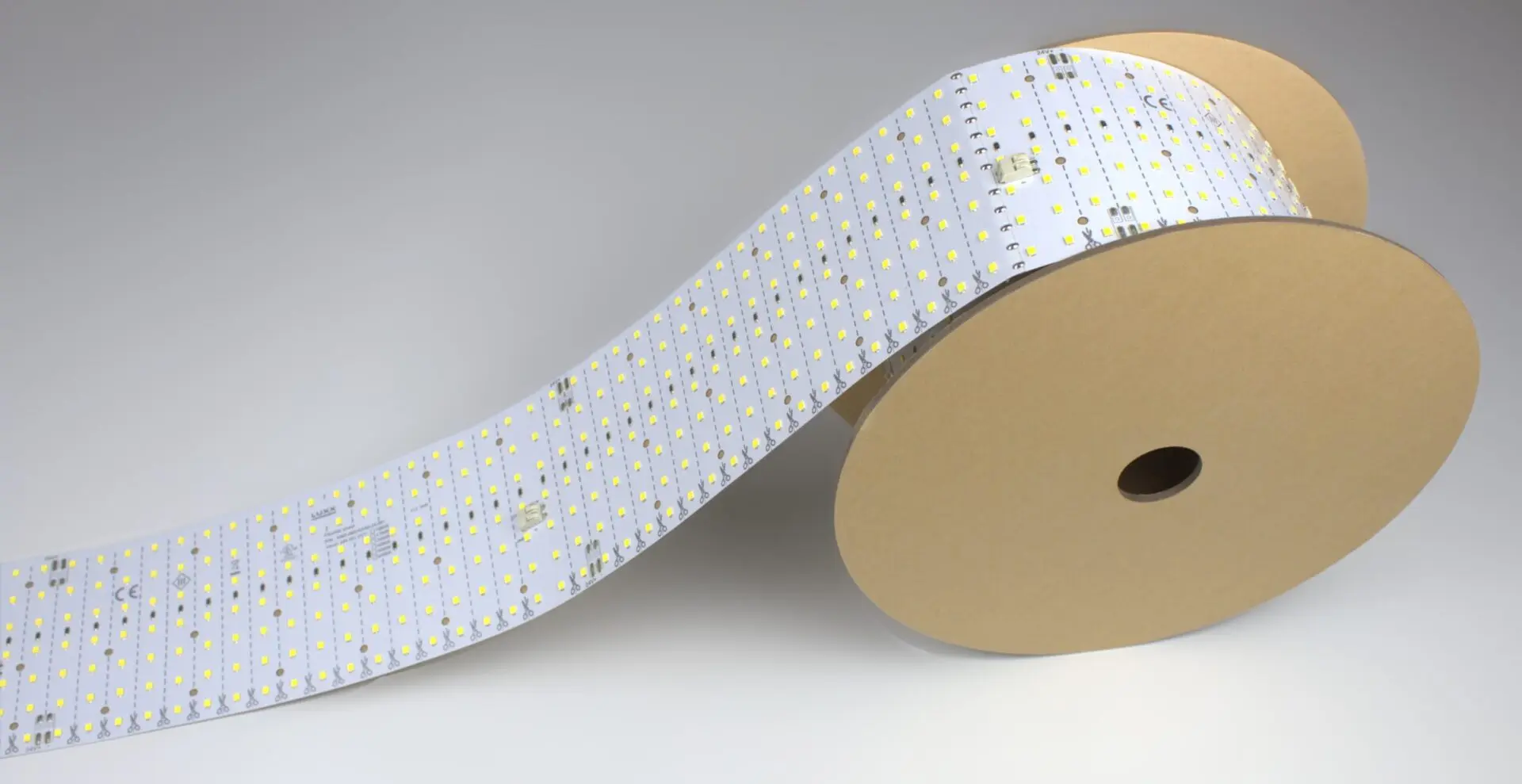
Bar tops are long and narrow: LightWave® Roll It! covers up to 40 ft continuous in the standard format, so one run can light the full length without a joint under the stone. Kitchen islands are large and often seen from all sides: tile Generation 1 Plus sheets edge to edge and zone the drivers. Vanities and sinks are small, shallow and near water: keep sheets in a sealed dry cavity and drivers outside the wet zone. Vertical bar fronts and backsplashes are covered on how to backlight an onyx wall; project budgets are in the cost guide.
Use case example: a backlit onyx bar front
A 14-foot backlit onyx bar front with a waterfall return at each end, joinery allowing roughly 25mm behind the stone, slab 20mm laminated to glass. At that thickness the stone diffuses weakly, so any source geometry behind it will read through to the face.
Cut Generation 1 Plus sheets at 2700K follow the bar front and turn the returns. At 648 diodes per 12 by 24 inch module there is very little to blend, which is what makes 25mm workable. The screw spacer set holds a consistent offset across the whole run — including at the mitred corners, where the temptation to press sheets flat is strongest and where inconsistent gap shows most clearly.
The step that decides the outcome is the slab mock-up before fabrication. Onyx varies in thickness and translucency across a single slab, and at full output veining commonly bleaches out and the stone loses depth. Establishing the working dimming level against the actual material determines both the commissioning setting and the driver sizing.
Related Applications
- Flexible LED Light Sheets — Product guide
- Hospitality Lighting — Similar use cases
- Heat Management — Spacing & thermal guidance
LightWave for Stone Backlighting
-
- Gen 1 Plus — Standard option, 324 LEDs/sq ft
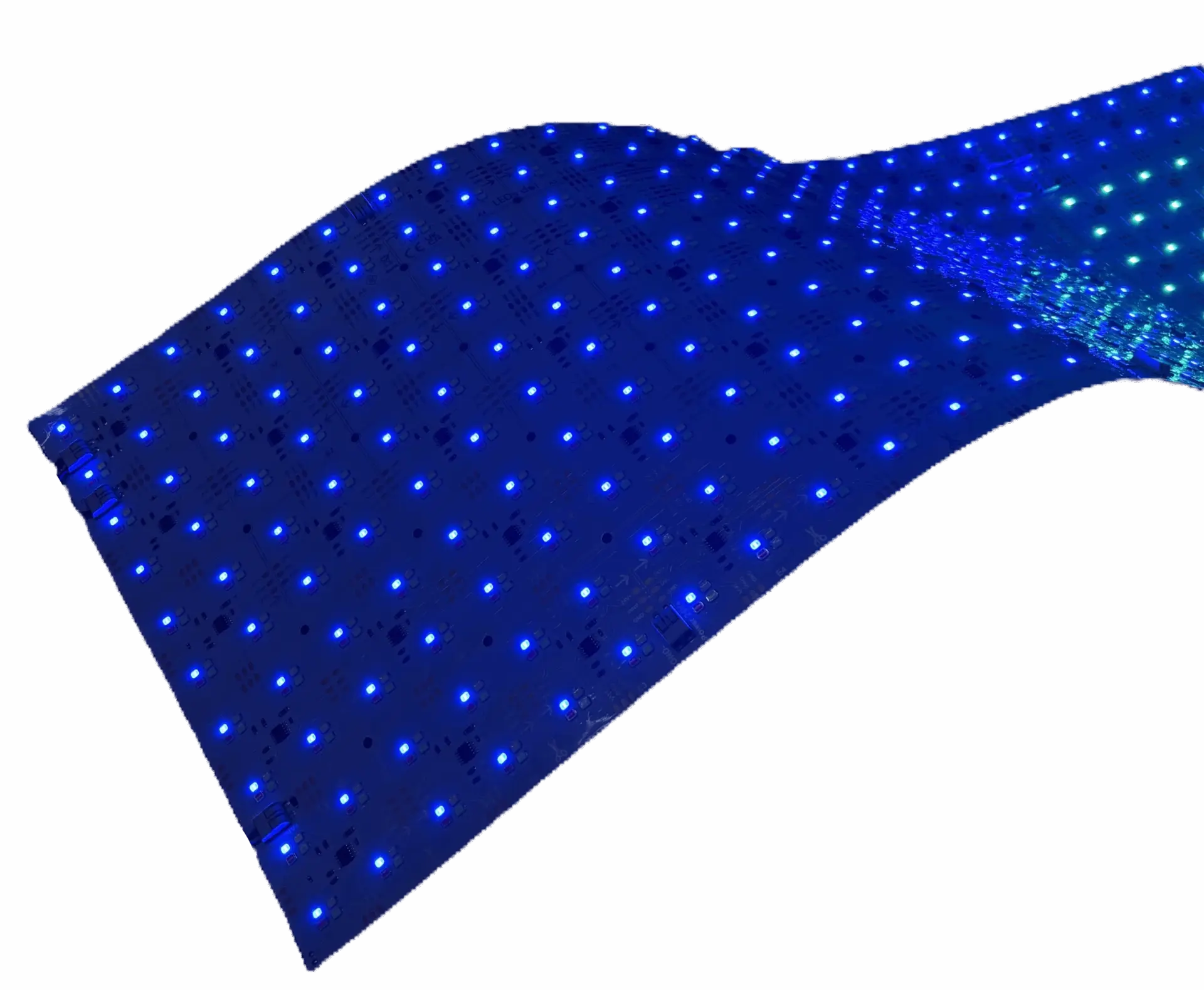
- CH2 RGBW — Color-changing backlit stone
- Screw spacer sets ensure even 2–3″ spacing
LightWave® products used for this application: Generation 1 Plus (most slabs) · CH2 (true-color stone) · Roll It! (long bar tops). Specify with: power supply calculator.