

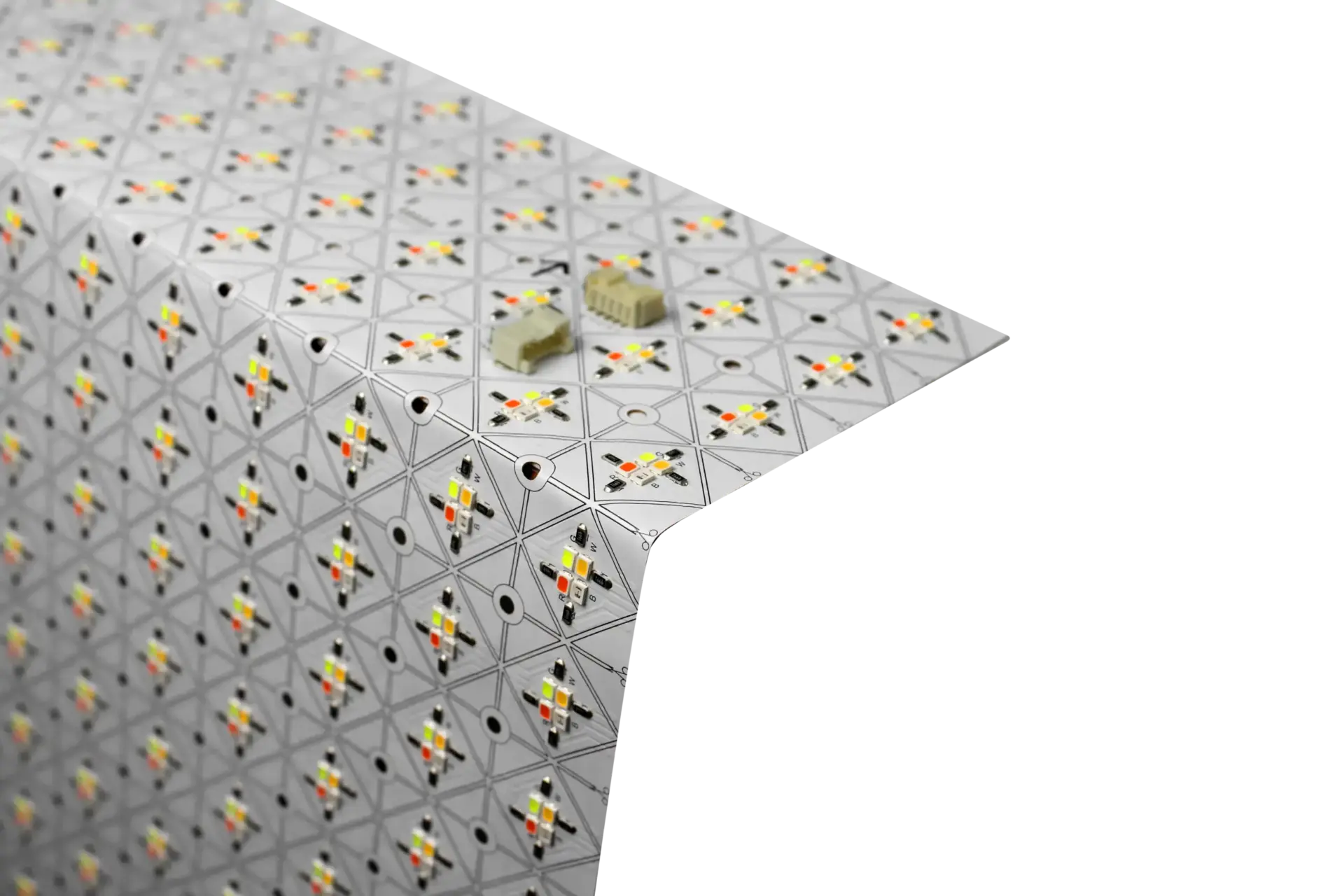
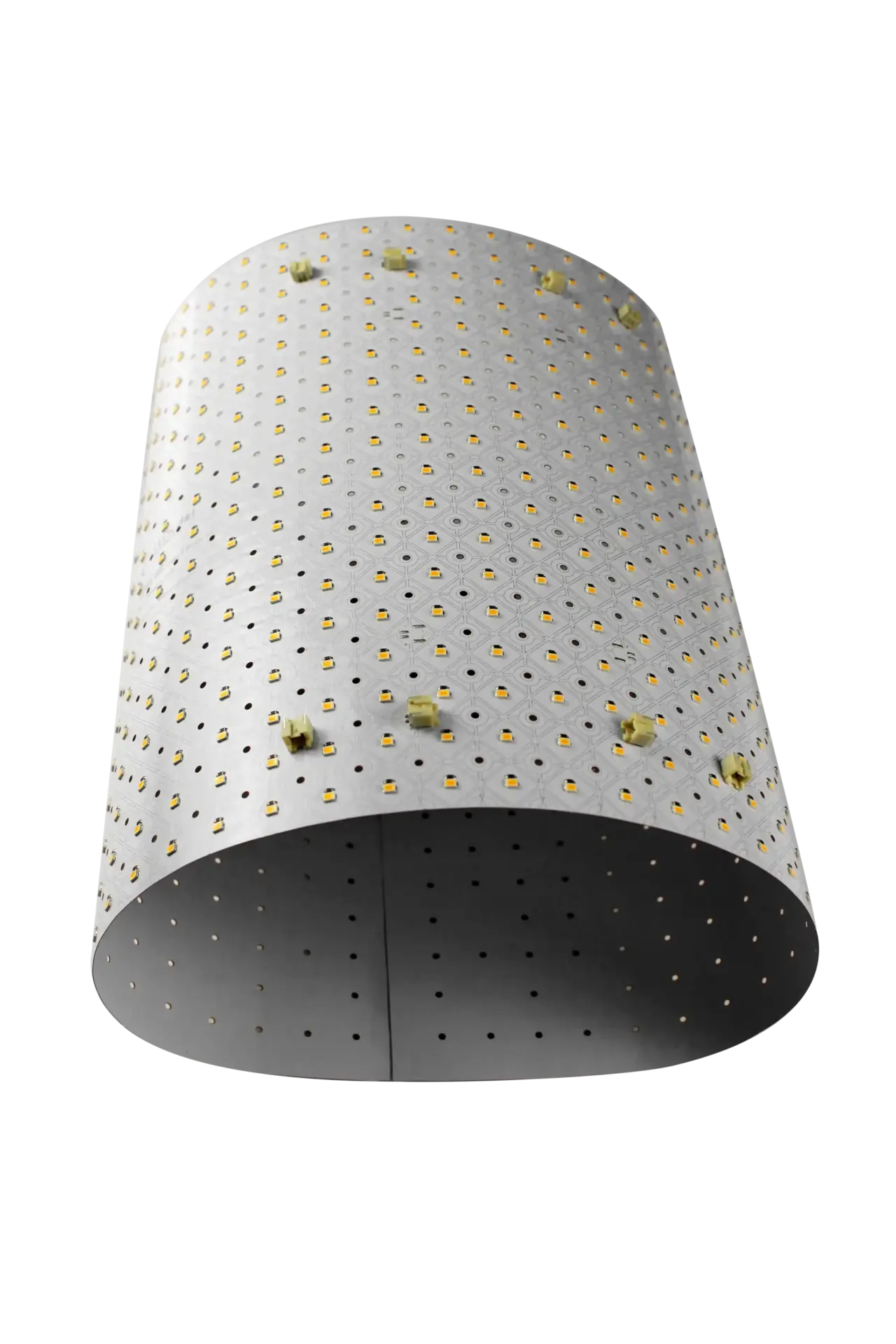
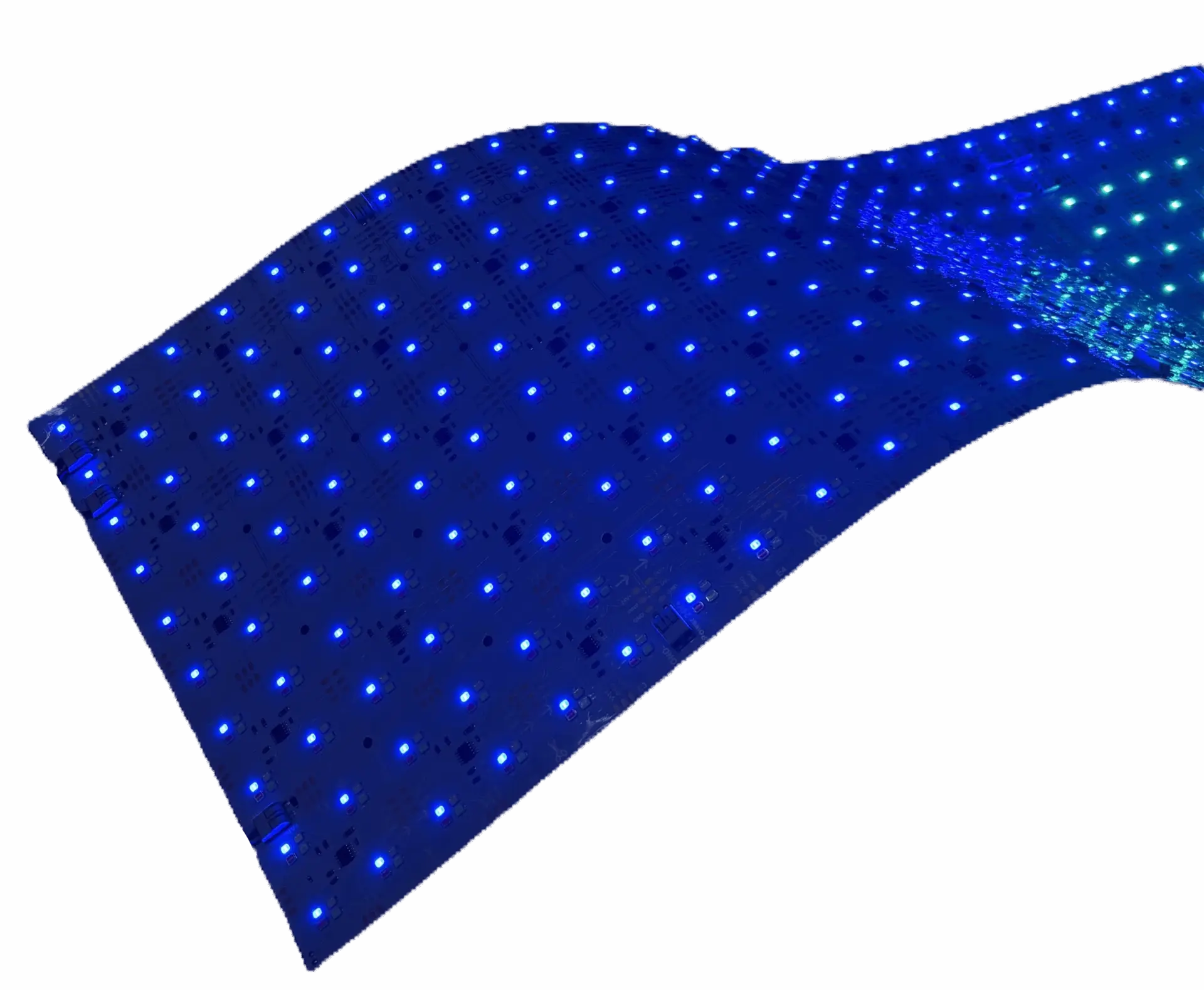
Quick Answer: LightWave® LED sheets can provide broad illumination inside shallow architectural cavities where a conventional rigid fixture or widely spaced LED strips may not fit. Their under-7-mm profile and flexible construction allow the sheet to follow curved millwork and concealed surfaces. Use the sheet when the goal is an evenly illuminated surface or reflected wash rather than a visible linear light source, and verify the cavity depth during installation planning.
Cove lighting is judged by what you cannot see. The fixture is concealed; the product is a continuous band of light washing a ceiling or wall. When it works, the eye reads an unbroken gradient. When it does not, the failure is always the same — a visible rhythm of bright and dim along the run, betraying where the individual sources sit.
Scalloping is the standard term and the standard problem. It comes from point sources at intervals, and the conventional remedies are to move the source further from the washed surface or to space the sources more closely. In a cove detail, the first option usually is not available, because the cove dimension was drawn before the lighting was selected.
Why do cove lights scallop?
Point sources at intervals
A strip places diodes along a line at fixed spacing. Close to the emitting plane, each diode is still a discrete source. Light needs distance to overlap into a continuous field, and a cove throwing light onto a ceiling only a short distance above provides very little. The result is a repeating pattern of brighter and darker zones across the washed surface.
Joins between sections
Modular fixtures and cut strip runs meet at joins, and at every join the diode spacing is interrupted. A run assembled from many sections produces a visible dark interval at each meeting point, precisely where the eye is scanning for continuity.
Corners and returns
Coves turn corners. Linear fixtures do not turn well, and a mitred join between two runs is one of the most visible failure points in the detail. Where a cove wraps around a radiused column rather than a straight wall, see LED for curved surfaces and columns.
“Scalloping in a cove comes from point sources spaced too far apart. An area source removes the problem instead of hiding it.”
— Aweyer, Lighting Applications Engineer, LUXX
How does a light sheet prevent cove scalloping?
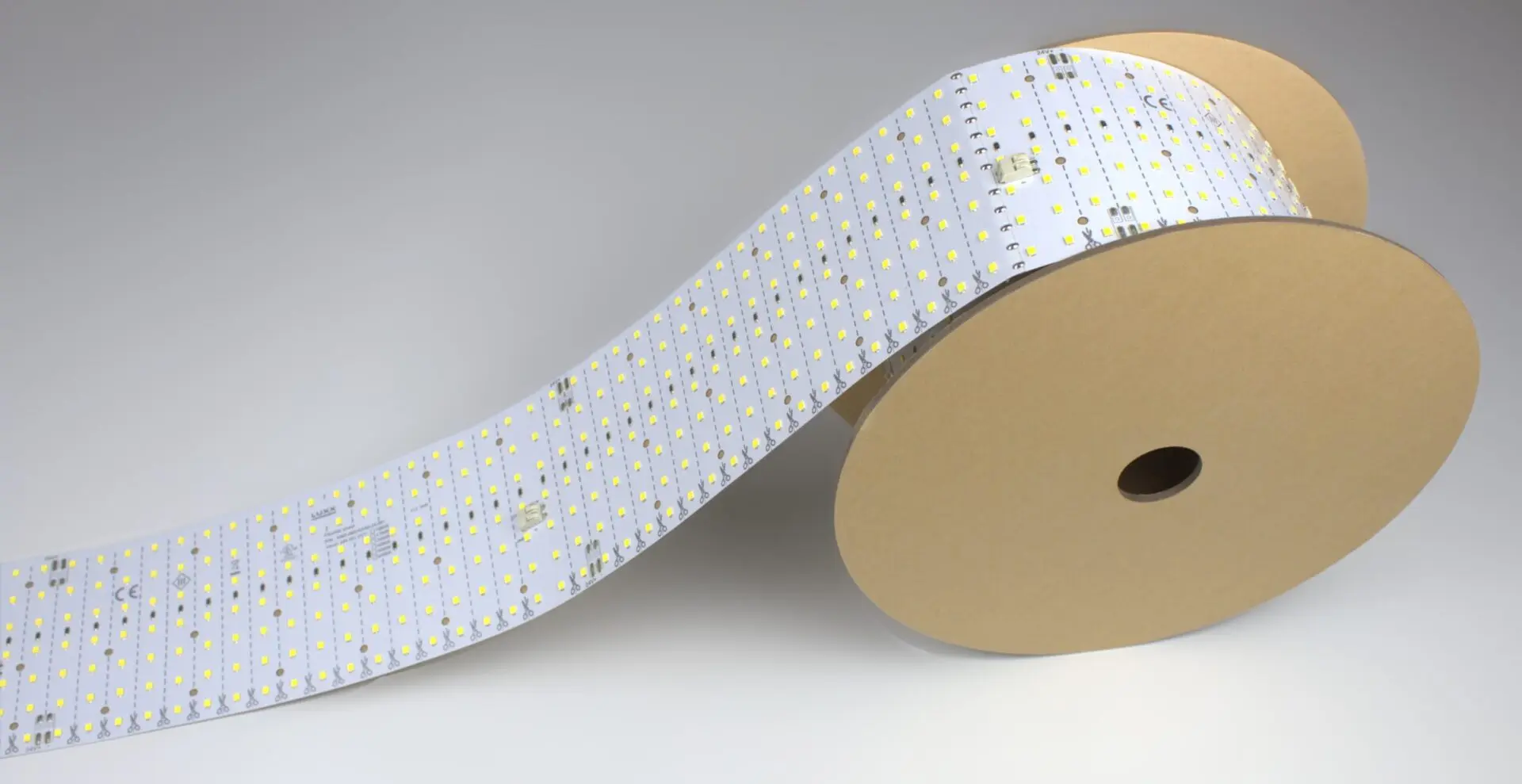
LightWave Roll It! is 4 inches wide with 324 LEDs per square foot, delivered in continuous lengths up to 40 feet. Two properties matter here. Roll It! is one product within LUXX’s flexible LED light sheets range, built specifically for continuous, join-free runs.
Area emission instead of a line
The emitting surface is a band rather than a line, and the diodes across it are densely packed. There is far less to blend, so the short throw distance a cove offers is sufficient rather than marginal. The washed surface reads as a gradient rather than a rhythm.
Continuity up to 40 feet
A 40-foot cove run can be one continuous piece with no joins to reveal themselves on the ceiling above. This is the property that most directly addresses the scalloping problem, because it removes the interruption entirely rather than trying to hide it.
Fewer drivers and less congestion
Powering one long section rather than a chain of small ones means fewer drivers, fewer splices, and less wiring inside a cove detail that has no room to spare. Every splice is a labour item and a potential failure point, and a cove is a difficult place to service — anything mounted there should be specified with the assumption that reaching it later is expensive.
How do you specify a cove?
Detailing the cove itself
The cove dimension and the lighting should be decided together, not sequentially. Confirm the throw distance from the sheet to the washed surface, the depth available for the sheet and its driver runs, and whether the lip conceals the source from every viewing angle in the room — including from a mezzanine or stair if the space has one.
Color temperature
Cove lighting is ambient and generally warm. 3000K to 3500K covers most commercial and hospitality interiors, with 2700K where the scheme is residential or intimate. 3500K is standard stock on Roll It!; warmer temperatures are available across its wider color range at 115 to 130 lm/W, dropping to 100 lm/W at 1800K. Because a cove washes a large surface, the temperature choice drives the perceived temperature of the whole room — it is not an accent decision.
CRI
Ra 80+ is correct. A cove illuminates a ceiling or wall plane; nobody judges an object’s color against it. Roll It! is rated above 80.
Power and dimming
Roll It! draws 2.15W per foot (6.6W per square foot) in its higher-efficacy configuration and 3.5W per foot (10.7W per square foot) across the wider color range. Coves are almost always dimmed, since the ambient level needed in the evening differs sharply from daytime. Confirm the dimming protocol with the controls contractor before the driver package is ordered.
Batch consistency
A cove is a single continuous band the eye scans end to end. Order the full run quantity from one production batch. LUXX bins within a 3-step MacAdam standard, which is what keeps a long run reading as one field rather than as sections of slightly different white.
Which cove and recess details suit LED sheets?
- Perimeter ceiling coves and recesses
- Wall-washing slots and reveals
- Stair and corridor light troughs
- Bulkhead and soffit details
- Lobby and atrium perimeter lighting
- Reception and feature-wall grazing
- Curved and radiused cove runs
The same batch-consistency discipline applies to backlit onyx and stone countertops, where slab variation raises the stakes further.
Use case example: a continuous lobby cove
A perimeter cove running 120 feet around a corporate lobby with several radiused corners, where the cove detail and ceiling were built before the lighting package was awarded. The throw to the ceiling plane is short and cannot be increased.
Short throw is precisely the condition where strip arrays scallop, because spaced point sources need distance to overlap. Roll It! at 3000K is 4 inches wide with 324 LEDs per square foot, so there is far less to blend and the wash reads as a gradient at the distance available.
At 120 feet the run exceeds the 40-foot continuous length, so it splits. The decision worth making deliberately is where: placing joins at the radiused corners rather than mid-wall puts them where a change in geometry masks them. Driver count also falls against a strip scheme, which matters when the ceiling void offers limited access — fewer devices above a finished ceiling means fewer reasons to open it later.
What does an LED cove lighting detail look like?
A standard cove detail places the light source on the cove’s back or floor, below the sight line from anywhere in the room, with the cove lip shielding direct view and the ceiling acting as the reflector. With LightWave® Roll It!, the 4″-wide roll lies flat on the cove floor or back in one continuous run up to 40 ft, so the wash has no dark gaps at joints.
What is coveless cove lighting?
Coveless (or “cove-less”) lighting achieves a cove-style wash without building a drywall cove, usually with a slim profile mounted to the wall or ceiling edge. An under-7 mm light sheet is thin enough to hide in a shallow reveal or behind a crown molding, giving a continuous wash where there is no room for a traditional cove.
LightWave® products used for this application:
Roll It! (continuous runs up to 40 ft with no dark gaps at joints).
Specify with: