

Quick Answer: LightWave® LED sheets are well suited to retail displays because their dense LED layout produces broad, even illumination behind shelves, graphics, translucent panels and product displays. The sheets are under 7 mm thick and can be cut to fit custom display dimensions. For merchandise where color accuracy matters, the CH2 RGBW build reaches CRI 90, helping products and materials appear closer to their intended color.
Retail display lighting has one job that separates it from every other backlighting application: a customer is going to look at merchandise under it and decide whether to buy. That decision frequently turns on color — whether a garment is charcoal or navy, whether a foundation matches, whether two pieces coordinate. Lighting that renders color poorly does not just look worse. It loses sales at the fixture and generates returns when the item is seen in daylight.
That makes color rendering the governing specification here, in a way it is not for signage or architectural work. LightWave® CH2 RGBW reaches CRI 90, which is the figure to specify wherever a customer performs a color judgment.
Why does CRI govern retail display specification?
The customer is color-matching
Whether or not they think of it that way, a shopper examining apparel, cosmetics, or jewelry is performing a color-matching task under your lighting. Low-CRI sources distort that judgment. The two outcomes a retailer cares about — a sale not made, and a return processed — both follow from a customer being unable to trust what they see.
Backlit casework is the demanding case
Ambient retail lighting washes a space the customer moves through. Backlit casework does something harder: it illuminates merchandise being examined closely, often at arm’s length, sometimes through or against a lit panel. There is no distance to soften a rendering deficiency.
Where 80+ is still correct
Not every lit surface in a store needs CRI 90. Backlit brand walls, illuminated graphics, fascia signage, and color-change feature surfaces are all conditions where the light is the feature and nothing behind it is being evaluated. Ra 80+ is correct and more efficient there. Specifying by zone rather than applying one figure across the whole package is normal practice. The same color-accuracy logic governs museum exhibit backlighting, where the CRI 90 requirement is even less negotiable. For the parts of a store that are purely graphic — brand walls and fascia — see LED backlit signage.
How do you backlight shelves?
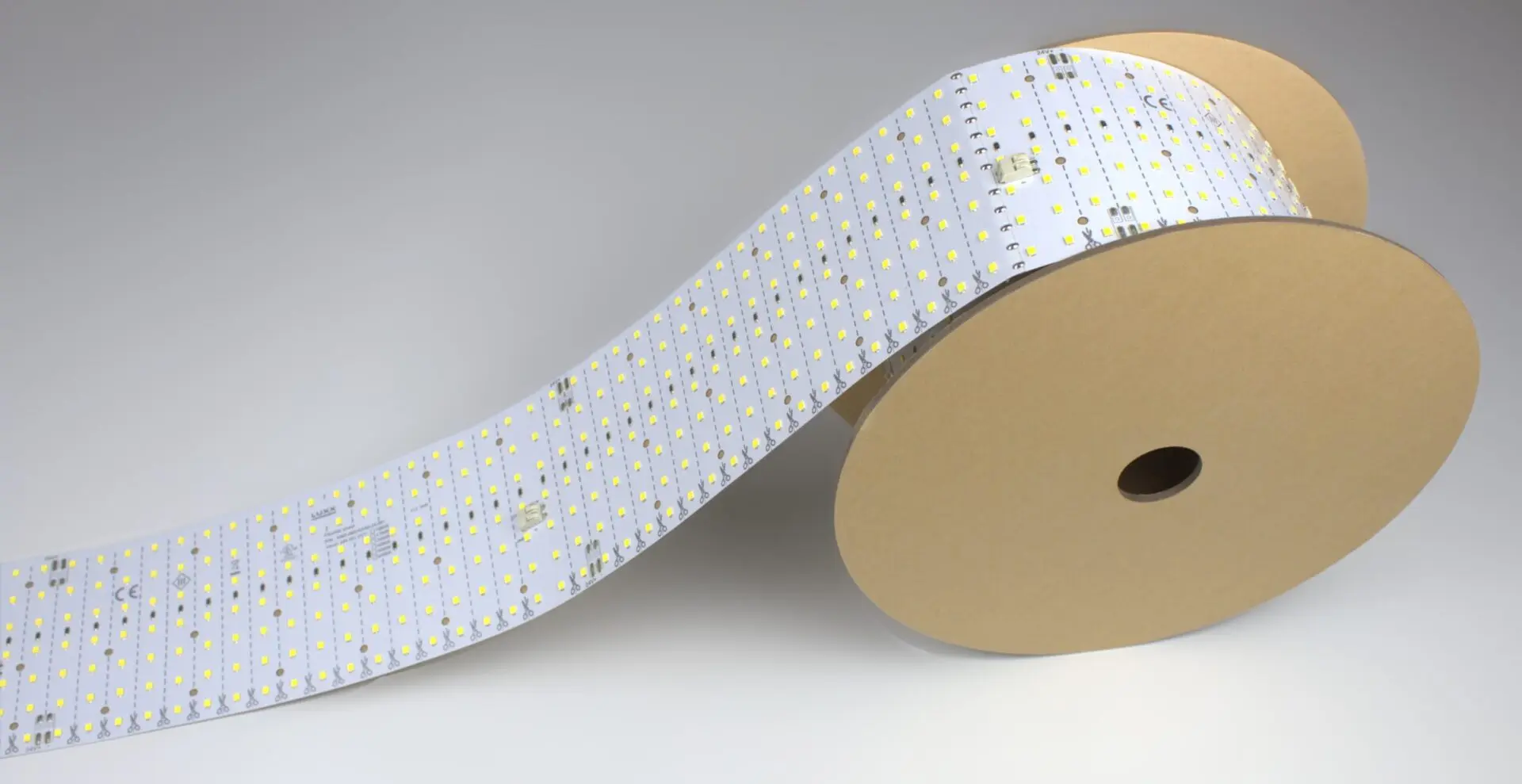
Backlight a shelf by lighting the translucent panel behind or beneath the products, not the products themselves. Cut LightWave® sheets to the shelf back or base, hold an air gap behind an opal acrylic or glass panel, and run the wiring down the shelf upright to a hidden driver. A 12″ × 24″ Generation 1 Plus sheet covers 2 sq ft at 14 W, so a 4 ft × 2 ft shelf back takes four sheets. For floating shelves, Roll It! at 4″ wide fits inside the shelf body along its full length.
Why specify CH2 for merchandise display?
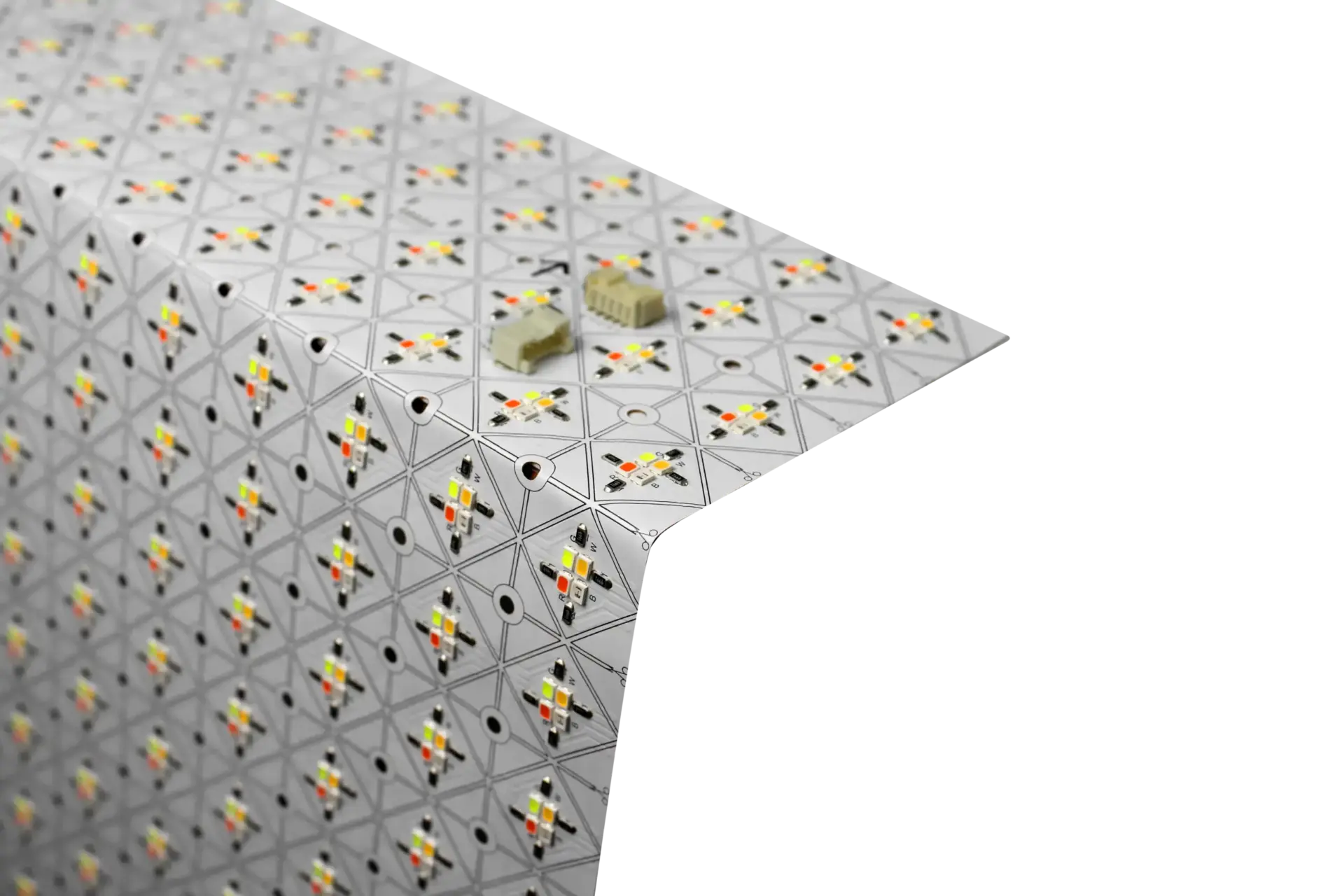
CH2 RGBW is rated CRI 90 at its 5000K white channel, producing 900 lumens from four channels at 11W each, above 90 lm/W. CH2 is also available in tunable white at 2700K to 6500K, two channels at 20W each, producing 1,800 to 1,850 lumens — but rated Ra 80+, not 90.
That distinction matters on a submittal. Specifying “CH2” alone does not secure CRI 90. Where color accuracy is the requirement, write CH2 RGBW explicitly and confirm it on the approved submittal rather than assuming. CH2 sits within LUXX’s broader flexible LED light sheets range alongside Roll It! and Generation 1 Plus.
Color change as a merchandising tool
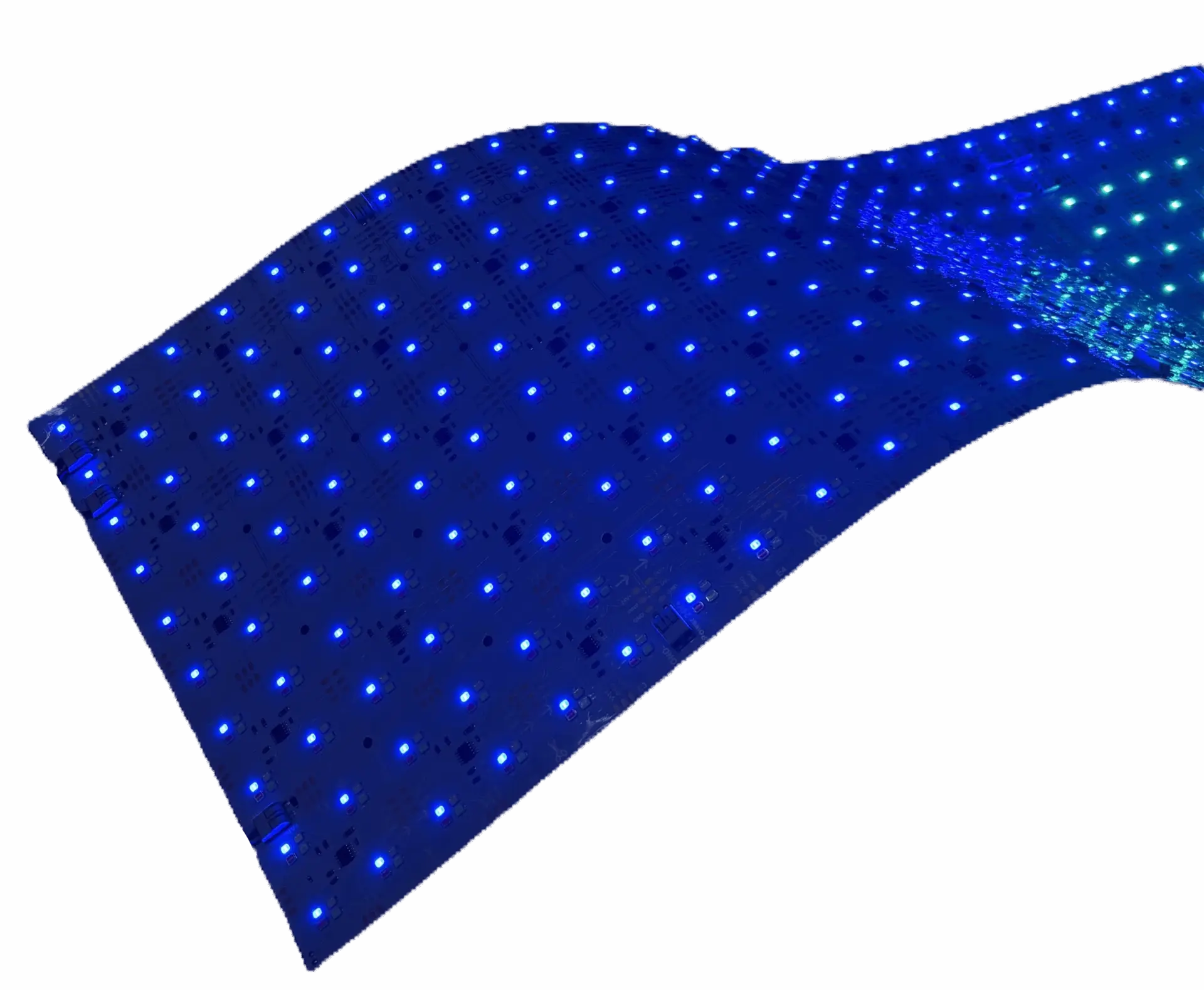
The RGBW configuration carries a second benefit beyond its CRI rating. The same fixture can hold a true-color 5000K white for product evaluation and shift to a brand color or seasonal palette for a promotional period. That is a static color change across the whole sheet, not motion — if the display needs animation or gradient, that is PIXX, at substantially higher power and commissioning cost.
Fitting the fixture
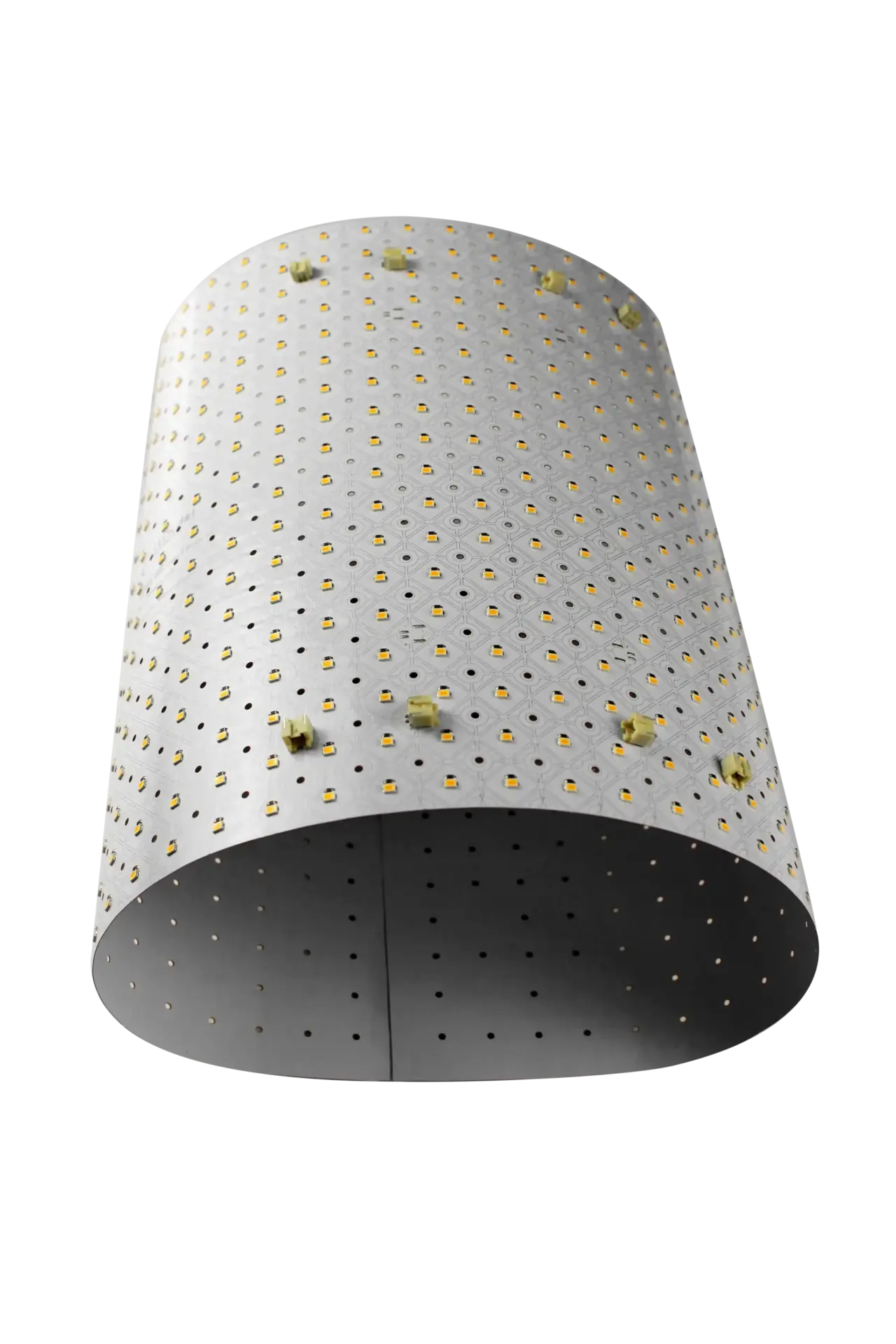
CH2 sheets are 12 by 24 inches, under 7mm, and cut along designated lines. Retail casework is rarely modular: shelf backs, vitrine panels, cash-wrap surrounds, and column displays all have their own dimensions. Cutting to the fixture rather than sizing the fixture to the light is what keeps the lighting package from driving the millwork.
How do you specify retail display backlighting?
Consistency across the floor
A store is a series of fixtures the customer walks between, comparing as they go. Sheets that differ in tone from one fixture to the next read as a quality problem even when each fixture is individually acceptable. LUXX bins its LEDs within a 3-step MacAdam standard, which constrains diode-to-diode deviation. Order the full quantity for a store or a rollout phase as a single batch, because topping up later with a fresh production run is the most reliable way to introduce a visible mismatch.
Color temperature
General and apparel retail typically sits at 3500K. Grocery, food merchandising, and task-oriented retail run 5000K, where crispness reads as freshness. Where CH2 RGBW is used, the white channel is 5000K, so mixing it with static 3500K sheets in adjacent fixtures will show — plan the white temperature across the whole floor rather than fixture by fixture.
Power and dimming
CH2 RGBW draws four channels at 11W each; tunable white draws two at 20W. Size drivers for all channels running. Retail displays are commonly dimmed for evening trading and after-hours window presence, so confirm the dimming protocol with the controls contractor before the driver package is ordered.
Heat in enclosed casework
Vitrines and closed display cases restrict airflow. The screw spacer set provides thermal clearance alongside its optical function, and in an enclosed case that clearance protects both the LEDs and, where relevant, the merchandise.
Which retail fixtures benefit most?
- Apparel wall bays and shelf backs
- Cosmetics and fragrance counters
- Jewellery and watch vitrines
- Cash-wrap and point-of-sale surrounds
- Illuminated shelving and product plinths
- Window display backdrops
- Food and grocery merchandising cases
Use case example: a cosmetics tester counter
A cosmetics counter where customers select foundation shades at a tester station. This is the clearest case of a customer performing a color-matching task under the fixture lighting, and it is where rendering quality converts directly into either a sale or a return.
CH2 RGBW is the specification, rated CRI 90 at its 5000K white channel and producing 900 lumens from four channels at 11W each. The RGBW capability is a secondary benefit: the same fixture holds true-color white for normal trading and shifts to a brand palette for campaign periods without a second lighting system.
Two details carry the job. Sheets cut to the counter surround rather than the surround being redesigned around a module, since retail casework is rarely modular. And the full rollout quantity ordered as one production batch, so that a customer sees the same shade in any store — which is the entire point of specifying for color accuracy in the first place.
LightWave® products used for this application:
- Generation 1 Plus — Ambient ceilings
- CH2 — Tunable white ceilings
Specify with: power supply calculator · tunable white LED sheets