Quick Answer:
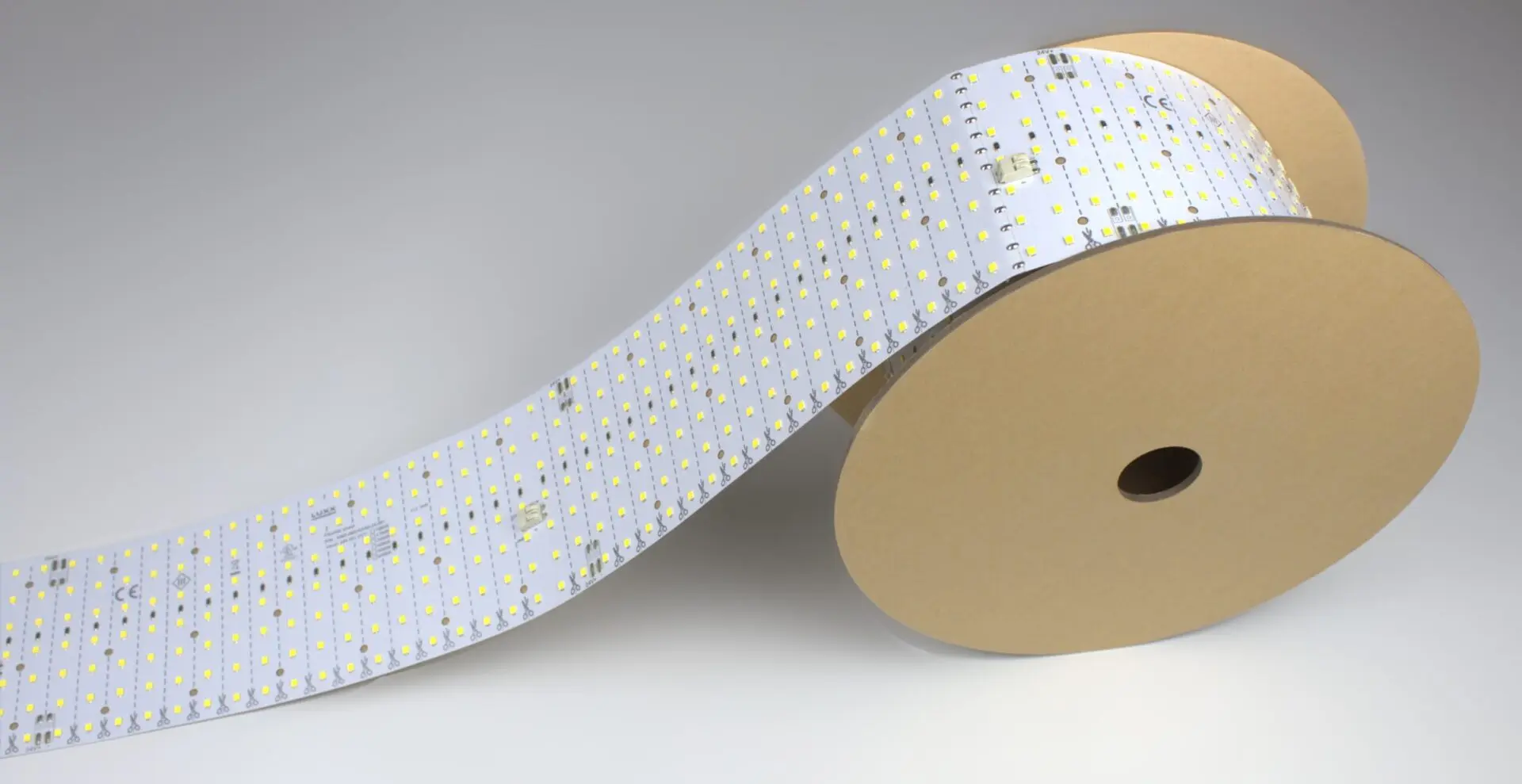
Use an area light source that covers the whole sign face, keep a consistent gap between the light and the face, and size the output to the face material. LightWave® sheets cut to the face shape; for long, narrow fascia bands, Roll It! covers up to 40 ft in one run with fewer drivers and no splices across the graphic.
A backlit sign succeeds or fails on evenness. Brightness is easy to achieve and easy to specify. What separates a sign that reads as a clean illuminated plane from one that looks cheap is whether the viewer can see the light source through the face — bands, dots, bright centres, dark corners. Those artefacts are geometry problems, and they are decided at specification, not on site.
Flexible LED sheets solve them by emitting across the full area from the outset rather than approximating a field with parallel lines. LightWave® Roll It! extends that to continuous lengths up to 40 feet, which is what makes large-format signage and billboard work practical without a congested cavity full of splices.
Why is backlit signage difficult to light evenly?
Three constraints collide in almost every sign cabinet.
Shallow cabinets
Sign cabinets are dimensioned by the fabricator and the mounting condition, not by the lighting. Slim profiles are fashionable and often structurally necessary on fascia and monument work. That leaves very little distance between the light source and the face material — and distance is exactly what a linear source needs to blend into an even field.
Large uninterrupted faces
A sign face is one continuous plane the eye can scan across in a single glance. Unlike a room, where lighting variation goes unnoticed because there is no reference, a sign face provides its own reference along its entire width. Any variation across it is immediately visible.
Irregular shapes
Channel letters, logos, and shaped cabinets rarely align to a rectangular lighting module. A source that cannot be cut to shape forces either wasted coverage or dark areas at the extremities.
“Sign backlighting is all about consistency. LightWave’s uniform matrix means the entire sign face glows—no bright spots, no dead zones.”
— aweyer, Lighting Applications Engineer, LUXX
How do flexible LED sheets produce even signage backlighting?
Density does the blending
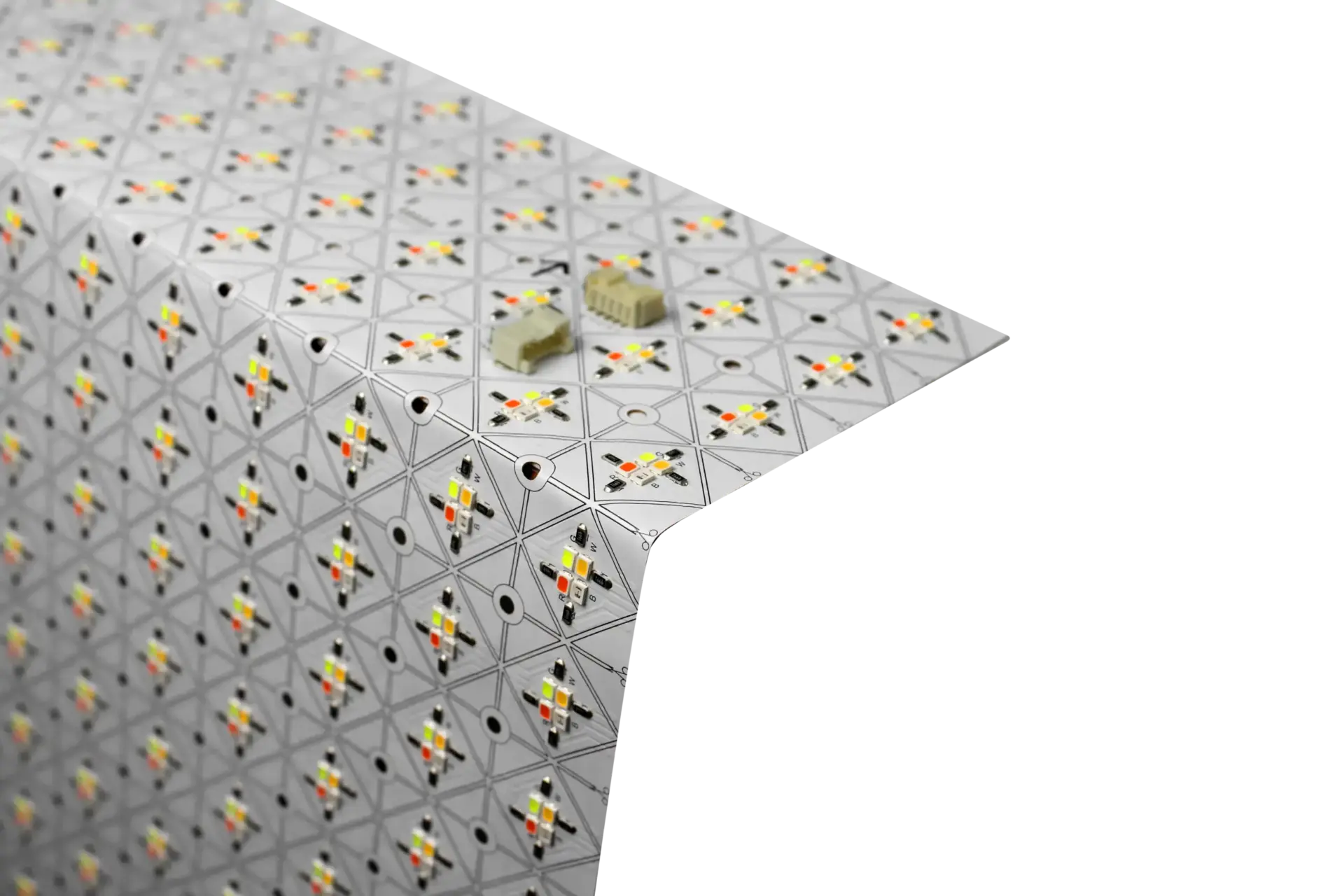
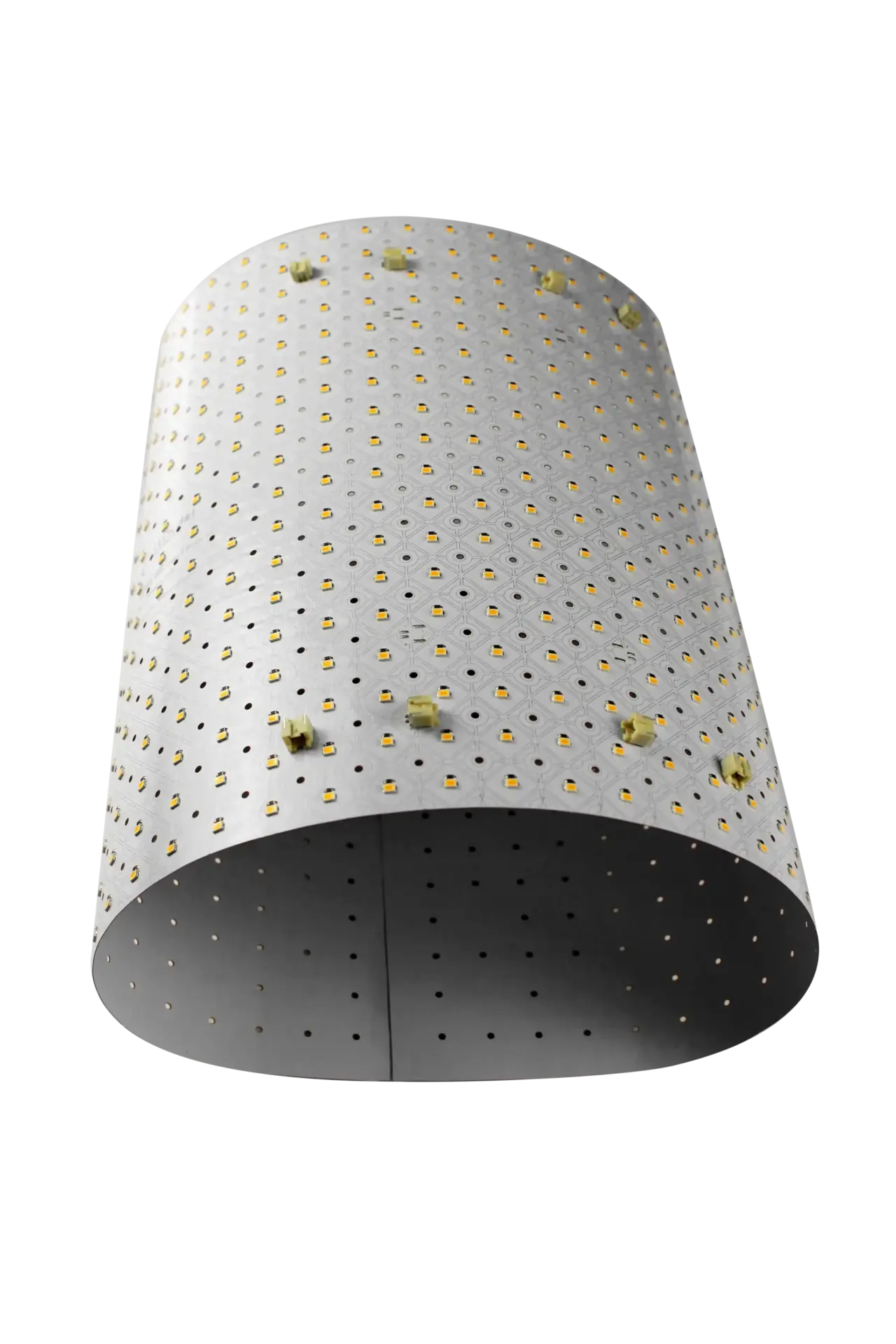
Roll It! carries 324 LEDs per square foot at under 7mm thick. Because the emitting sources are already close together, the distance needed for them to merge into a continuous field is small. That is the difference between a sign that works in a two-inch cabinet and one that requires four inches of depth the fabricator does not have.
These are the same flexible LED light sheets used across LUXX’s architectural and retail lighting ranges, engineered specifically to solve this kind of even-illumination problem.
Cutting to the sign shape
LightWave sheets cut along designated lines, so the lit area follows the sign face rather than the other way round. For shaped cabinets and logo work, Roll It! can be combined with the cuttable LightWave products — a long run handled by Roll It!, with irregular returns and letterforms filled by cut Generation 1 Plus. Match color temperature across products at specification so the join is invisible.
The screw spacer set
LUXX supplies a screw spacer set that holds the sheet at a fixed offset from the face material. This sets the blending gap by component rather than by installer judgment, and provides thermal clearance that helps the sheet age evenly. On a sign face, where evenness is the entire product, this is not an optional accessory.
How does a roll format reduce drivers and splices?
A continuous roll powers a long sign as one section instead of a chain of panels, which removes drivers, splices and wiring congestion at the same time. A 30-foot fascia sign lit with modular panels means a chain of sections, each with its own connections, tied back to multiple drivers. The same run in Roll It! is a single powered section.
The consequences compound across a project: fewer drivers to locate and service, fewer splices and connectors, and less wiring congestion inside a cabinet that has no room to spare. Every splice is both a labour line item and a potential failure point, so removing them improves installed cost and long-term reliability simultaneously. On a sign mounted twenty feet up a facade, the reliability half of that matters more than the cost half.
How do you specify a backlit sign?
Color temperature
Roll It! offers 3500K, 5000K, and 6500K at 130 lm/W, and the full 1800K to 6500K range at 115 to 130 lm/W. For most exterior signage 5000K reads clean and bright against a night sky. Interior wayfinding and retail fascia often sit at 3500K to match surrounding ambient. Whatever is chosen, specify it against the ambient the sign will actually be seen in — a 5000K sign in a 2700K hospitality lobby looks cold regardless of how correct 5000K is in isolation.
CRI
Ra 80+ is the correct specification for signage. Nobody evaluates the color of an object under a sign face; they read the sign. Specifying CRI 90 here spends efficacy on a difference the application cannot show.
Power
Roll It! draws 2.15W per foot (6.6W per square foot) in its higher-efficacy configuration, and 3.5W per foot (10.7W per square foot) across the wider color range. Calculate against the illuminated area, add the headroom your electrical engineer specifies, and size drivers to that total rather than to the calculated minimum.
Face material
The diffusion characteristics of the face material change how much blending gap is required. A heavily diffusing acrylic is forgiving; a lightly diffused or translucent vinyl face is not. Confirm the face specification before finalising cavity depth, because these two decisions are coupled and are usually made by different parties.
Which signage types suit flexible LED sheets?
- Fascia and building-mounted signage
- Monument and pylon signs
- Backlit billboards and large-format advertising faces
- Channel letters and shaped logo cabinets
- Interior wayfinding and directory boards
- Menu boards and drive-through displays
- Transit and platform information signage
The same continuous-run approach also carries over to trade-show booth backdrops, where speed of install matters as much as evenness. For signage inside a retail environment where color accuracy also matters, see retail display backlighting.
How do you make a backlit acrylic or logo sign?
Cut the logo or face from opal or colored acrylic, mount it on stand-offs in front of a LightWave® sheet cut to the logo outline, and keep an even gap so the letters glow without bright spots. For a halo effect, mount opaque letters off the wall with the sheet behind them. A 12″ × 24″ Generation 1 Plus sheet covers 2 sq ft at 14 W, so most logo signs run on a single small driver.
Should you use LED modules or LED sheets in a sign?
LED modules are individual point sources spaced across the cabinet; they suit deep cabinets and large faces where depth allows blending. LED sheets put a continuous LED grid across the whole face, so they suit shallow cabinets, curved faces and signs where module shadows would show. See LED light sheet vs LED strip for the same trade-off with strips.
Use case example: a shallow-cabinet fascia sign
A retail fascia band runs 28 feet in a cabinet with under two inches of internal depth, fabricated before the lighting package is awarded. That depth is the governing constraint: a parallel-strip layout at that distance needs run spacing tight enough to suppress striping, and the resulting connector and driver count exceeds what the cabinet can accommodate.
Roll It! addresses both problems at once. At 324 LEDs per square foot the emitting surface is already continuous, so two inches is sufficient rather than marginal, and a 28-foot run sits inside the 40-foot continuous length so the whole band powers as one section. The screw spacer set fixes the offset from the face material by component rather than by installer judgment.
If the same sign were rolled out across multiple sites over several months, the whole sheet quantity would be ordered from a single production batch. LUXX bins LEDs within a 3-step MacAdam standard, which is what makes color consistent across locations rather than approximate.
Explore Sign Lighting
- Flexible LED Light Sheets — Product overview
- Color Temperature Guide — Choosing the right CCT
- Trade Show Booth Lighting — Similar application
LightWave for Sign Backlighting
- Gen 1 Plus — Standard, 324 LEDs/sq ft, up to 14W
- CH2 — High-output, 40W, for larger signs
- 4000K–5000K (neutral white) standard for sign legibility
LightWave® products used for this application:
- Generation 1 Plus — Ambient ceilings
- CH2 — Tunable white ceilings
- PIXX — Animated ceilings
- Roll It! — Ceiling bands and coffers
Specify with: power supply calculator · tunable white LED sheets