Quick Answer:Most backlit signs use 5000K–6500K for crisp whites and saturated graphics, while backlit stone and hospitality surfaces usually look best at 3000K–3500K. Match the color temperature to the material and the surrounding lighting, and use tunable white (2700K–6500K) when the setting must change.
Correlated color temperature is the single most visible specification decision in a light sheet package. Get the CRI wrong and a discerning client notices. Get the color temperature wrong and everyone notices — a hospitality space lit at 6500K feels like a laboratory, and a grocery display at 2700K makes produce look tired. See the full flexible LED light sheet range for products across the CCT spectrum.
This guide covers what CCT measures, the range available across the LightWave line, how to match temperature to application, and when tunable white is worth its added cost and control complexity.
What does color temperature (CCT) actually measure?
Color temperature is expressed in kelvin and describes where a white light source sits on the warm-to-cool axis. The scale is counter-intuitive: low numbers produce warm, amber, yellow-leaning light, and high numbers produce cool, blue-leaning light that reads as daylight. Candlelight sits near 1800K. Domestic incandescent lamps sat around 2700K. Overcast midday daylight runs above 6000K.
Correlated Color Temperature (CCT) is standardized by the Illuminating Engineering Society, with recommended ranges published in the IES Lighting Handbook. Standard CCT values include 2700K (warm white), 4000K (neutral), and 6500K (cool daylight).
The U.S. Department of Energy’s Solid State Lighting program provides guidance on selecting appropriate CCT values for different applications and explains how color temperature affects circadian rhythm and occupant well-being.
Specifiers should consult IES recommendations when selecting CCT for retail, hospitality, or architectural lighting projects to ensure consistency with lighting design standards.
CCT describes the appearance of the light itself. It says nothing about how accurately that light renders color, which is a separate specification — see High-CRI LED light sheets explained.— covered in its own guide. A 3000K source and a 5000K source can share identical CRI, and two sources at the same CCT can render color very differently. Specify both.
Why the number is a decision, not a default
There is no universally correct color temperature. The right answer depends on what the space is for, what is being illuminated, what surrounds the installation, and in commercial work, what the brand’s other locations already use. A backlit feature that reads beautifully in isolation will look wrong if the ambient lighting around it sits two thousand kelvin away.
What color temperatures are available?
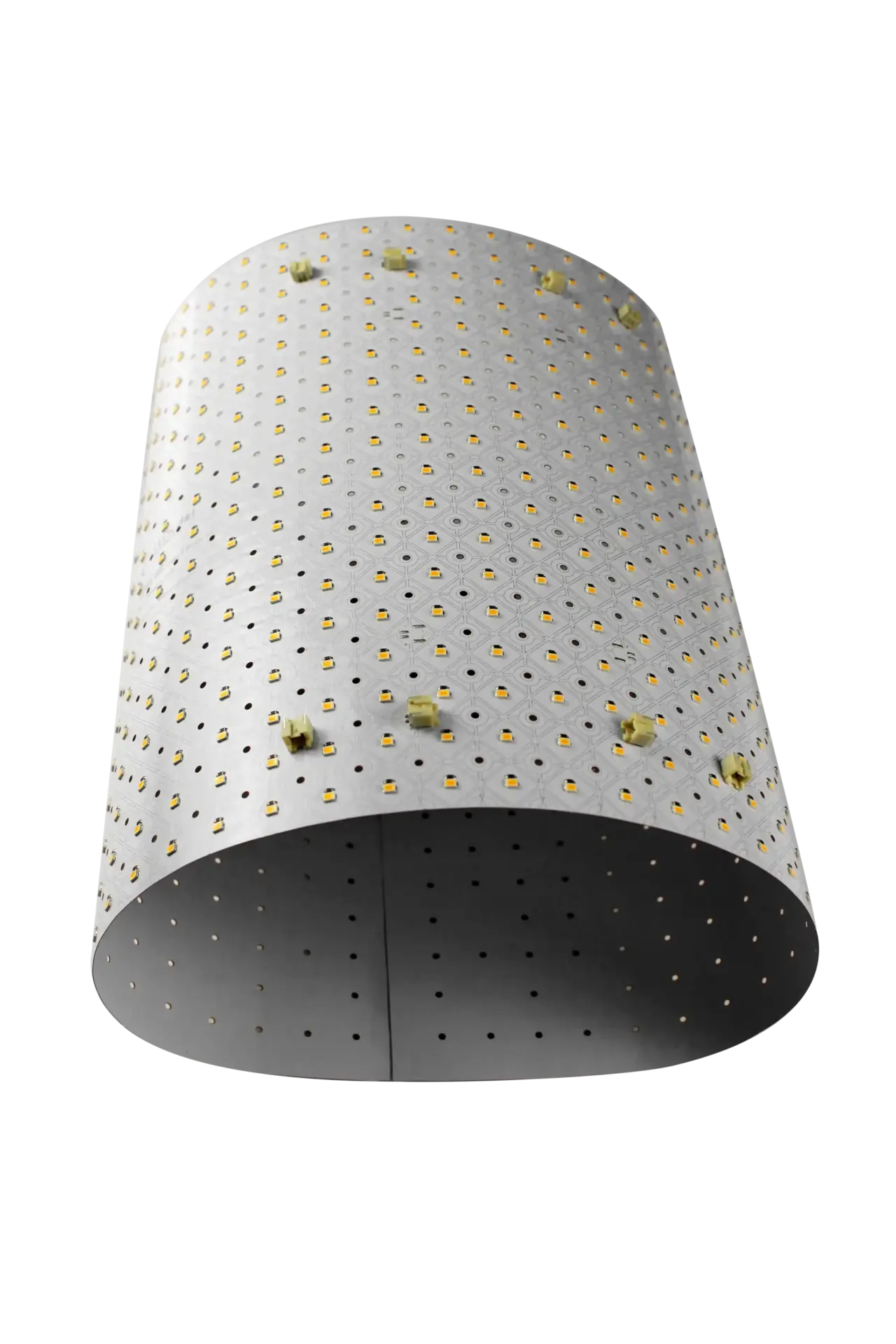
LightWave covers 1800K through 6500K, though availability differs by product and configuration.
What each product offers
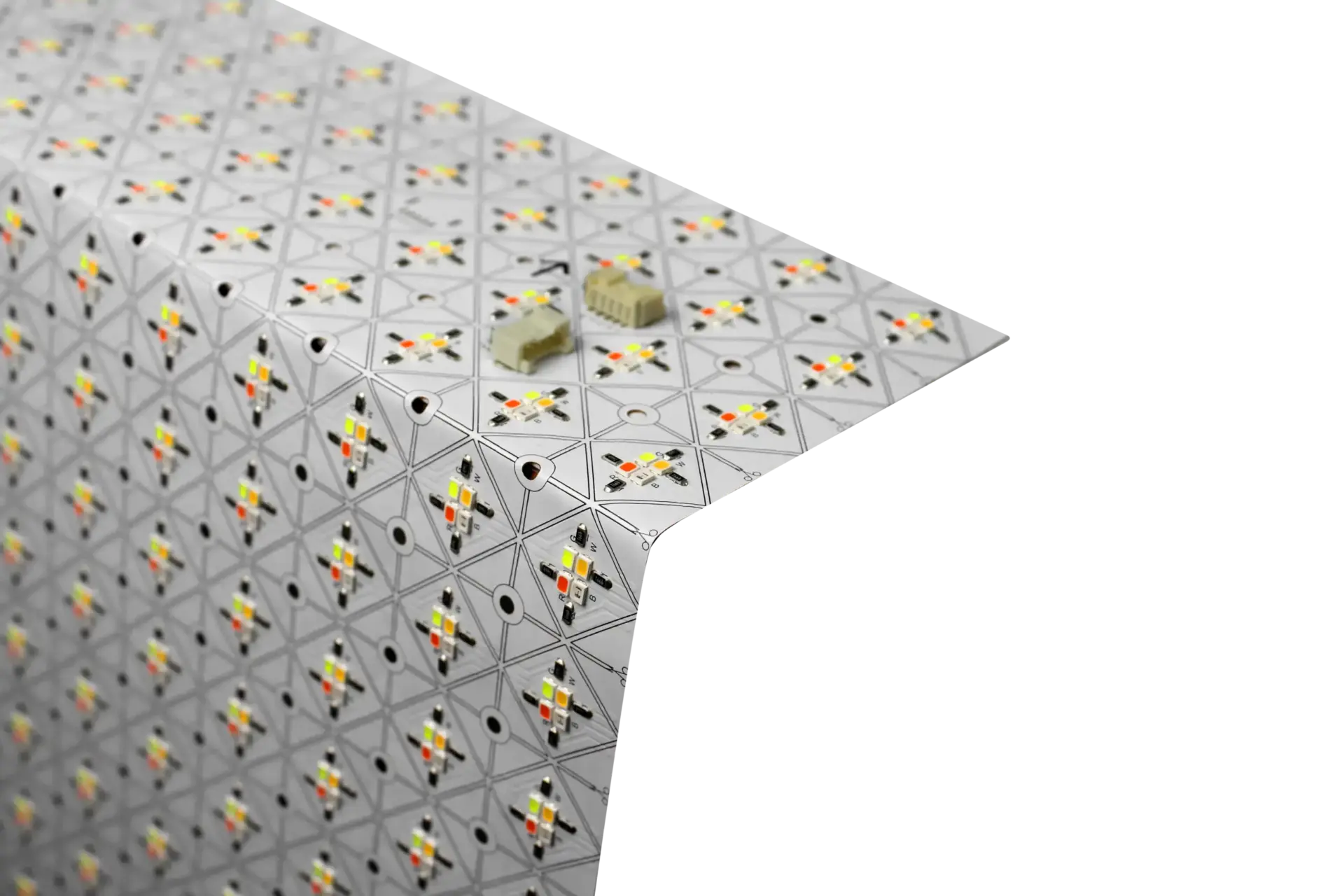
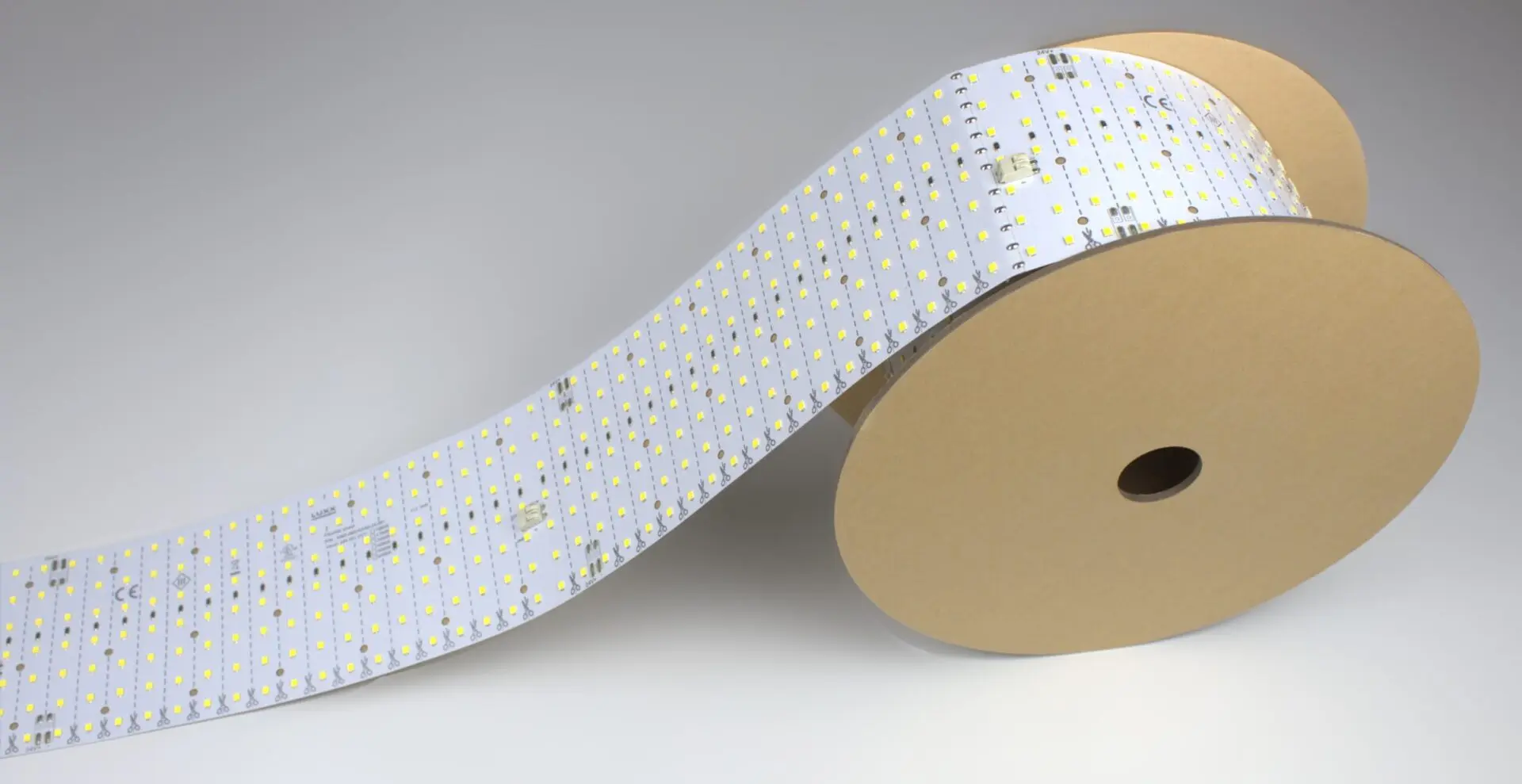
Generation 1 Plus lists 3500K, 5000K, and 6500K as standard stock, with 1800K, 2700K, 3000K, and 4000K available by request. Roll It! offers 3500K, 5000K, and 6500K in its higher-efficacy configuration at 130 lm/W, and the full 1800K to 6500K spread in its second configuration at 115 to 130 lm/W. Tunable white on both Generation 1 Plus and CH2 sweeps 2700K to 6500K under controller command. PIXX and the RGBW variants use a dedicated 5000K white channel alongside red, green, and blue.
The efficacy cost at the warm end
Very warm output costs efficiency. Roll It! drops to 100 lm/W at 1800K, against 115 to 130 lm/W across the rest of its range. That is a real consideration on large installations: the same illuminated area at 1800K draws meaningfully more power and generates more heat than it would at 3500K. It does not make 1800K a wrong choice — the candlelight effect is not available any other way — but it should be budgeted for rather than discovered.
Standard versus by-request
The distinction between stock and by-request temperatures is a schedule item, not a technical one. Specifying 2700K on Generation 1 Plus is entirely reasonable and should be confirmed against lead time before the construction programme hardens around it. Where the schedule is tight and the exact temperature is not load-bearing to the design, a standard temperature removes risk at no visual cost.
Which color temperature should you use for each application?
1800K to 2700K — warm and atmospheric
This is mood lighting. Bars, lounges, restaurants, boutique hospitality, and residential feature work. The 1800K end mimics candlelight and is a deliberate effect rather than a general-purpose choice. Warm temperatures flatter skin tones and make timber, brass, and leather look richer. They also mute blues and greens, which matters if anything in the space depends on those reading accurately.
3000K to 3500K — warm neutral
The default for general commercial and hospitality interiors, and the safest choice when the brief is simply that the space should feel welcoming. 3500K is stock on both Generation 1 Plus and Roll It!, which makes it the low-friction option for schedule-sensitive work.
4000K — neutral
Offices, healthcare, education, and any environment where the light should read as neutral rather than expressive. On Generation 1 Plus this is a by-request temperature, so confirm lead time.
5000K — cool neutral
Grocery, task-oriented retail, food merchandising, and any application where crispness reads as cleanliness. Fresh produce, fish counters, and bakery displays are conventionally lit cool because it signals freshness. 5000K is also the dedicated white channel in the RGBW and PIXX products, so where a project mixes static white sheets with RGBW color-change surfaces, 5000K keeps the white output consistent across both.
6500K — daylight
Industrial, inspection, and specific display contexts where neutrality outweighs warmth. It is rarely the right choice for a space people occupy at length, but it is correct where color judgment against a daylight reference matters.
Matching the surroundings
Whatever temperature is chosen, the surrounding ambient lighting sets the context in which it is judged. A 4000K backlit feature in a 2700K room reads as cold and slightly clinical even though 4000K is a perfectly neutral temperature in isolation. Specify the backlighting against what will actually be in the room, not against the abstract scale.
When is tunable white worth specifying?
Tunable white uses two channels of different color temperature, mixed under controller command to produce any point between them. On both Generation 1 Plus and CH2 the range is 2700K to 6500K.
When it earns its cost
Two situations justify it. The first is circadian and wellness lighting, where the temperature shifts across the day — cooler in the morning to support alertness, warmer through the evening — in healthcare, senior living, education, and workplace projects. The second is multi-use space, where the same room hosts a daytime function and an evening one and must feel different in each: a hotel function room, a flexible retail floor, a restaurant serving both lunch and dinner service.
What it costs
Both channels must be powered. Generation 1 Plus tunable white draws two channels at 14W each; CH2 draws two channels at 20W each. Size drivers for both running rather than for a single channel. There is also a controls and commissioning cost — someone must programme the schedule and someone must be able to adjust it later, which means the controls package and the handover documentation both grow.
When to skip it
If neither condition applies, a fixed temperature is cheaper to buy, simpler to power, and one less system to commission and hand over. Tunable white specified because it seemed like a useful option, then left at a single setting for its whole service life, is a common and avoidable expense.
Need one install that covers the whole range? See tunable white LED light sheets — 2700K–6500K from a single sheet via controller.
How do you keep color consistent across a large surface?
A color temperature on a datasheet describes a nominal target. What the eye judges on a finished installation is whether the sheets match each other, and that is a different question.
Why batch variation shows
LEDs vary between production runs. A diode nominally rated 3500K may render slightly green or slightly pink relative to another 3500K diode from a different batch. On a small fixture nobody notices, because there is no adjacent reference to compare against. On a thirty-foot backlit wall assembled from many sheets, that variation reads as visible banding — subtle patches of warmer and cooler light that the eye picks out immediately because the surface is continuous.
LUXX bins its LEDs within a 3-step MacAdam standard, which constrains how far any individual diode can deviate from the nominal target. For large-format work this is the specification that determines whether the wall reads as one field of light. When comparing manufacturers, ask about binning tolerance specifically: a product with excellent published efficacy and loose binning will disappoint on any surface large enough to compare against itself.
Ordering from one batch
Where a single continuous surface is being built from multiple sheets, order the whole quantity at once so it comes from one production run. Topping up a large installation months later with a fresh batch is the most reliable way to introduce a visible seam into a surface that was previously even.
Color shift over service life
Color temperature drifts as LEDs age, and the rate depends heavily on operating temperature. The hottest sections of an installation age fastest, which reintroduces patchiness on a surface that was uniform at handover. Thermal clearance is therefore a color-consistency measure as much as a longevity one — which is part of why the screw spacer set, by establishing an air gap behind the sheet, contributes to how the installation looks in year five rather than only on day one.
What should a color temperature specification confirm?
Seven items should be confirmed before a light sheet package is released, covering the temperature itself, the context it will be judged in, and the control system that drives it.
- The chosen CCT, and whether it is standard stock or by-request on the selected product
- The ambient color temperature of the surrounding space it will be judged against
- Whether any RGBW or PIXX surfaces share the space, since their white channel is 5000K
- Whether tunable white is genuinely required, or a fixed temperature will serve
- For tunable white, driver capacity sized for both channels running
- Total quantity ordered as a single batch where one continuous surface is involved
- Dimming and color control protocol, confirmed with the controls package
CCT is one of eleven items on the full specification checklist — see the LED light sheet buying guide for the complete list.