

Quick Answer: LightWave® tunable-white sheets can support dynamic lighting schemes by changing color temperature from 2700K to 6500K throughout the day. A controller can shift the same backlit surface from warmer light toward cooler light without replacing the fixture. For circadian-oriented projects, the LED sheet is the illumination hardware rather than the complete lighting strategy, so the final schedule, intensity, spectrum and occupied-space requirements should be designed and validated as a complete system.
Circadian lighting design starts from a straightforward observation: human alertness, sleep, and mood follow a daily rhythm, and light is the strongest environmental signal entraining that rhythm. Daylight is cool and bright in the morning and warm and dim by evening. Interior lighting that holds one fixed color temperature for eighteen hours provides no such signal at all.
Tunable white lighting shifts color temperature across the day to reintroduce that variation. LightWave® tunable-white sheets sweep 2700K to 6500K under controller command, on both Generation 1 Plus and CH2.
A caution worth stating at the outset: circadian lighting is an active research area, and the evidence base is stronger for some claims than others. This page describes what tunable-white sheets do and how to specify them. Where a project makes health or performance claims, those should rest on current guidance from a qualified lighting designer or the relevant standards body rather than on manufacturer copy.
LightWave sheets enable circadian lighting through melanopic-sensitive color shifts,
ranging from 2700K (evening) to 6500K (morning).
For the full specification behind this — LED counts, channel wiring and controller
options — see tunable white LED light sheets.
What does tunable white lighting do?
Two channels, mixed
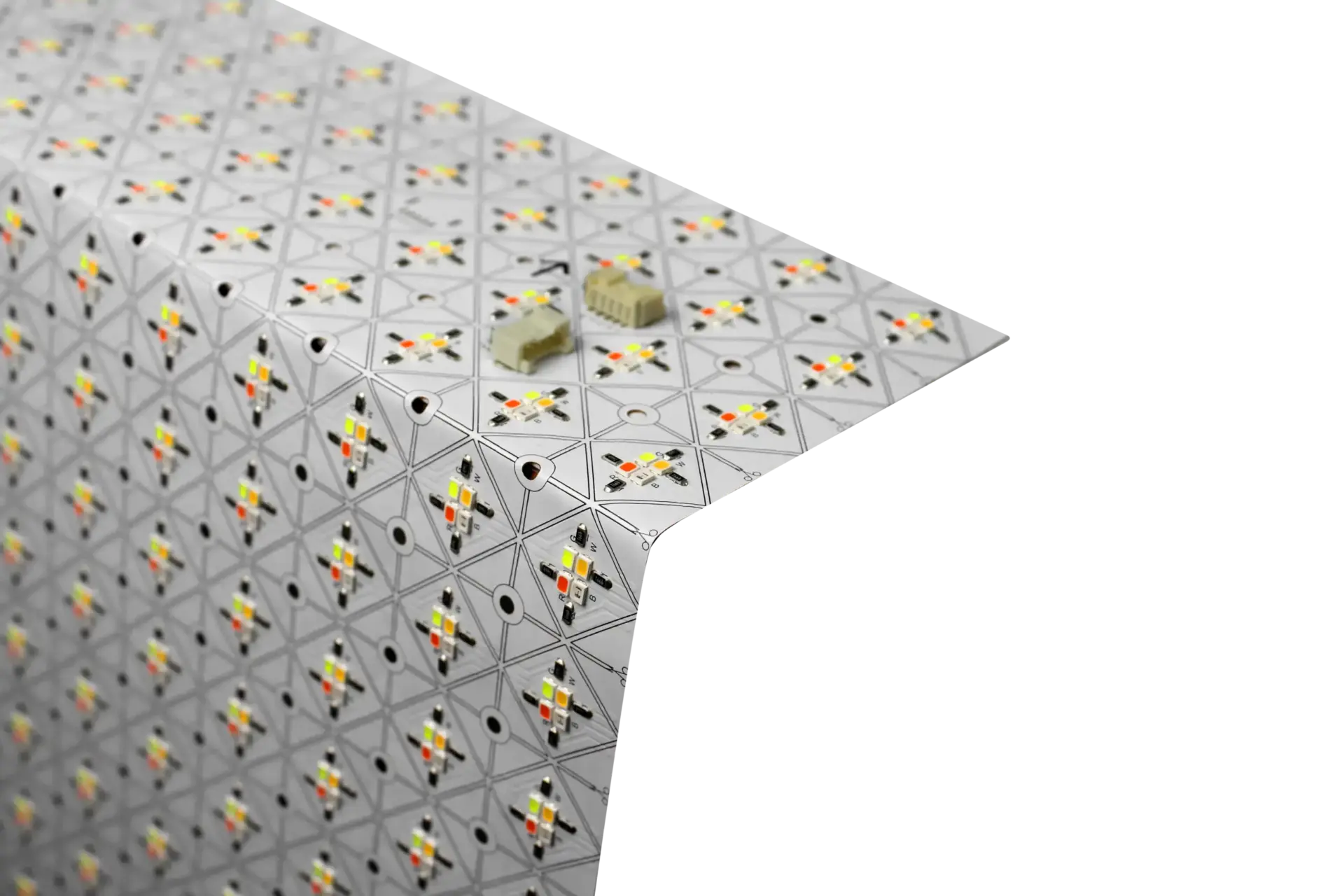
A tunable-white sheet carries two channels of differing color temperature, mixed by the controller to produce any point between them. Generation 1 Plus tunable white runs two channels at 14W each, producing 1,580 lumens at 2700K and 1,720 lumens at 6500K, at 113 to 123 lm/W, Ra 80+. CH2 tunable white runs two channels at 20W each, producing 1,800 lumens at 2700K and 1,850 lumens at 6500K, above 90 lm/W, Ra 80+. Tunable white is available across LUXX’s flexible LED light sheets range, on both Generation 1 Plus and CH2.
The typical daily curve
A conventional circadian schedule runs cooler and brighter through the morning, holds a neutral temperature across the middle of the day, and warms progressively through the afternoon and evening. The 2700K to 6500K range covers this comfortably at both ends.
Circadian-aligned lighting design is increasingly recognized in building standards. The WELL Building Standard includes specific credits for circadian lighting design that support occupant health and well-being.
The International Commission on Illumination (CIE) has published melanopic metrics that quantify a light source’s ability to stimulate circadian photoreceptors. These metrics guide lighting professionals in designing spaces that support healthy circadian rhythms.
LightWave’s tunable-white and RGBW options are ideal for projects pursuing WELL Building Standard circadian lighting credits or implementing research-backed circadian lighting strategies.
What it is not
Tunable white is not color-change lighting. It moves along the white axis only — warm to cool — and cannot produce saturated color. Where a project needs both a circadian white schedule and colored feature lighting, those are two separate specifications, not one product doing both.
Why do backlit surfaces suit circadian lighting?
Large, glare-free luminous surfaces
The circadian response is driven by light reaching the eye, and a large diffuse luminous surface delivers that without the glare of a point source in the field of view. Backlit panels, illuminated ceilings, and lit wall planes are well suited to this, which is part of why sheet products appear in circadian schemes more often than their share of general lighting would suggest. Illuminated ceiling panels and coves are among the most common carriers for a circadian schedule — see architectural cove lighting.
Fitting existing construction
Circadian retrofits frequently go into occupied buildings — healthcare wards, senior living, offices — where the ceiling and wall construction is fixed. LightWave sheets are under 7mm and cut along designated lines, so they fit shallow cavities and existing detailing without rebuilding the enclosure.
“Tunable white isn’t just nice to have—it’s becoming a standard expectation in commercial design. Every project I spec now includes a daylight-to-warm-white shift to support circadian alignment.”
— Aweyer, Lighting Applications Engineer, LUXX
Even output across the range
Both tunable-white products hold Ra 80+ across the range, and output varies only modestly between the warm and cool extremes — 1,580 to 1,720 lumens on Generation 1 Plus, 1,800 to 1,850 on CH2. That matters because a schedule that changes brightness noticeably as it changes temperature draws attention to itself, and circadian lighting works best when occupants do not notice it operating.
How do you specify a tunable-white installation?
Size drivers for both channels
This is the most common specification error. Tunable white draws two channels simultaneously: 2×14W on Generation 1 Plus, 2×20W on CH2. Sizing the driver package for a single channel underpowers the installation and produces a system that cannot reach full output at either extreme. Calculate the connected load for both channels running, then add headroom.
The control system is the project
Tunable white is a controls specification as much as a luminaire one. Confirm the protocol with the controls contractor before the driver package is ordered, since a protocol mismatch discovered after installation usually means opening finished ceilings to correct it.
Equally important, establish who owns the schedule after handover. A circadian installation is only delivering anything if the schedule is running, and schedules that only the commissioning engineer understands tend to end up parked at one setting within a year. Specify the handover documentation and a named operational owner alongside the hardware.
Zone the building honestly
Not every space benefits. Circadian schedules make sense in areas people occupy for extended periods — wards, dayrooms, open-plan offices, classrooms. Corridors, storage, and transient spaces generally do not justify the additional cost and control complexity. Zoning by occupancy duration rather than applying the system building-wide is usually the difference between a scheme that gets funded and one that does not.
The IES Lighting Handbook recommends color temperature shifts throughout the day (IES). For office environments, cool white (5000K–6500K) during morning hours supports alertness, while warm white (2700K–3000K) in evenings prepares occupants for sleep.
Consistency across a zone
A tunable-white zone is judged as a single field: occupants see many surfaces at once and compare them without meaning to. Order the full zone quantity from one production batch. LUXX bins its LEDs within a 3-step MacAdam standard, which constrains diode-to-diode deviation — relevant here because a tunable system moves through its range together, and any mismatch between sheets shows differently at each point along the curve rather than staying constant.
Where CRI matters
Both tunable-white products are Ra 80+, which is correct for ambient and architectural circadian lighting. In healthcare settings where clinical color assessment happens — skin tone evaluation, wound inspection — that task lighting is a separate specification with its own higher CRI requirement, and should not be expected from the ambient circadian layer. Where clinical or color-critical task lighting is also required, see the CRI guidance on museum exhibit backlighting.
Which spaces benefit from circadian lighting?
- Hospital wards, dayrooms and patient rooms
- Senior living and memory-care environments
- Open-plan offices and focus areas
- Classrooms and study spaces
- Wellness, spa and treatment rooms
- Windowless and deep-plan interiors
- Shift-working control rooms and operations centres
Use case example: a senior living dayroom
Communal dayrooms in a senior living refurbishment, where residents spend most daylight hours and window access is limited on one elevation. The ceiling void is shallow and the building is occupied throughout the works.
Illuminated ceiling panels built from Generation 1 Plus tunable white, cut to the existing ceiling grid rather than rebuilding it, running cooler through the morning and warming across the evening. The under-7mm profile is what makes retrofit into fixed construction viable.
Two decisions determine whether this delivers anything. Drivers sized for both channels running — 2×14W, not 14W — because single-channel sizing leaves the system unable to reach full output at either end of the range. And the schedule handed to a named member of the facilities team with written documentation, because a circadian installation nobody owns drifts to a single fixed setting and stops doing the job it was specified for.
LightWave Tunable White Variants
- Gen 1 Plus Tunable White — Shifts 2700K to 6500K, CRI 80+, up to 14W per sheet
- CH2 Tunable White — Premium tuning, CRI 85+, up to 40W per sheet, wider color gamut
LightWave® products used for this application:
- Generation 1 Plus — Bottle shelves and back bars
- CH2 — Hospitality finishes
- PIXX — Color that changes through the night
Specify with: power supply calculator · RGBW LED light sheets